Ask GRAI Anything
Your Real Estate Questions, Answered Instantly via Chat

Help us make GRAI even better by sharing your feature requests.
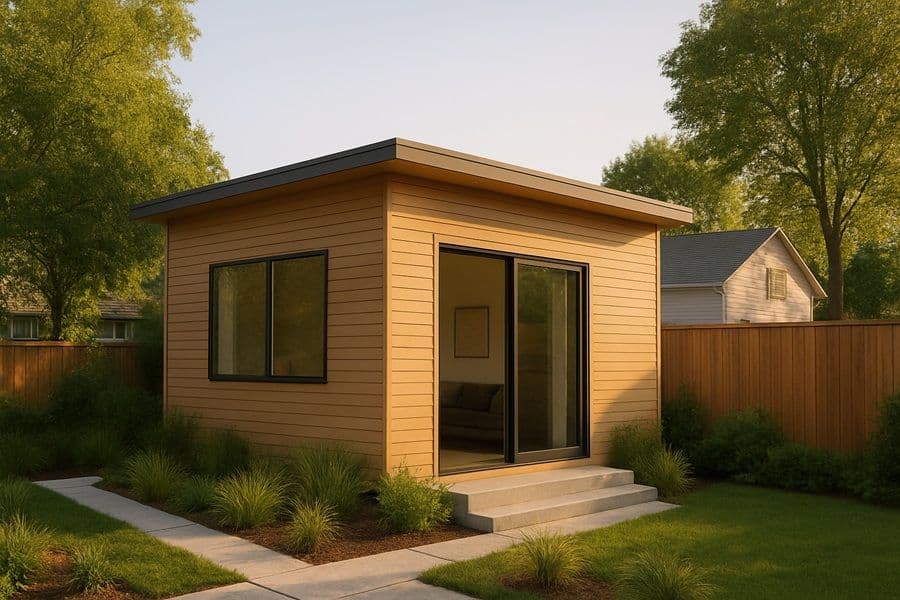
Accessory dwelling units moved from fringe idea to serious housing infrastructure in less than a decade. In 2025, ADUs are woven into zoning laws, lender handbooks, and city housing strategies across the United States. For homeowners and investors, they are no longer a curiosity. They are a real capital project with real upside and real risk.
This article looks at the ADU boom with current numbers, breaks down the economics, and shows how you can use GRAI both to test feasibility and to design livable small homes.
Fresh permit data shows the scale.
One national analysis of permit records counted about 2.8 million ADU permits in the United States through 2024, with California alone accounting for roughly 32% of all permits, followed by Washington at about 6% and Oregon at about 3%.
California’s own figures show that ADU permitting exploded after state reforms. Between 2016 and 2022 the number of ADUs permitted each year rose by more than 15,000%, leading to a cumulative 83,865 ADUs permitted over that period.
In the San Diego region, the 2024 ADU report counted 3,991 ADUs permitted in that year alone, and ADUs represented about 27% of all homes permitted in the region.
Seattle, Portland, Denver, Charlotte, Austin, Atlanta and a growing list of smaller cities are also reporting steep increases in ADU applications and completions. This is no longer a coastal experiment. It is a national pattern.
The ADU wave is not an accident. It is a direct outcome of law.
California, Oregon and Washington each adopted statewide ADU reforms that require local governments to treat compliant ADUs as a use that must be approved through a simple ministerial process rather than discretionary review.
Newer laws in Colorado, Arizona and Hawaii push local authorities to allow ADUs on many single family lots, often while limiting owner occupancy requirements or excessive parking rules.
California’s 2025 update increased the maximum number of detached ADUs that can be added to multifamily properties to as many as eight, subject to caps that match the existing number of units.
Cities such as San Diego went further with local bonus programs that allowed multiple ADUs per lot, to the point where ADUs made up roughly 20% of all homes permitted in 2023, before the city council began rolling back parts of that program in 2025 after neighborhood pushback.
The direction is clear. States have turned ADUs into a standard housing tool. Some cities are now calibrating the details, but the underlying right to build at least one small secondary unit is firmly established in a growing list of jurisdictions.
The economics have to start with a realistic budget. Based on broad national data and current contractor guides:
The typical ADU in the United States costs about $175,000 to build according to a 2025 renovation marketplace estimate, with more complex designs reaching $300,000 or more.
A national price review in 2025 noted that detached ADUs usually range from about $120,000 to over $300,000, attached ADUs from about $90,000 to $250,000, and garage conversions from roughly $50,000 to $150,000.
Converting those ranges into square footage, one widely used cost guide places average ADU construction costs around $150 to $300 per square foot nationally, with small units on the lower side and larger or higher finish units climbing higher.
Zooming in on specific metros:
In Los Angeles and much of Southern California, multiple builder guides advise using about $300 to $400 per square foot as a working estimate for a new detached ADU.
In San Diego, recent design build estimates suggest a total project cost of about $200,000 to $450,000 or more, with typical ranges of $375 to $600 per square foot depending on design complexity and site conditions.
In relatively lower cost markets like parts of Arizona or the Carolinas, current guides still place detached ADUs in the $120,000 to $300,000 band.
At the same time, certain highly constrained Bay Area projects can run much higher. One 2025 case study in Oakland described an ADU that would cost close to $500,000 because of structural work and an aging garage that needed complete replacement.
The headline is simple. For most homeowners, an ADU is a six figure project. Treat it like a small development, not like a weekend renovation.
On the income side, data has become richer over the last two years.
A 2024 ADU rental income review found that a 600 square foot ADU generated about $1,940 per month on average across the United States, and about $2,600 per month in higher income cities such as San Diego.
In Los Angeles, recent 2025 guidance for owners suggests that detached ADUs can often rent for about $2,000 to $3,500 per month, depending on neighborhood and amenity level. That is $24,000 to $42,000 in annual gross rent.
Realm, which tracks renovation returns, has reported that ADUs significantly boost appraised home values in many California markets and that homes with ADUs appreciated faster between 2021 and 2023 than comparable homes without them.
For returns, one construction firm’s 2024 analysis used Los Angeles County ADU projects and found that typical net returns ranged between about 7% and 15% once stable rents were in place.
These numbers are not guarantees. They are a reminder that in the right locations, an ADU can be a serious income engine rather than symbolic extra space.
Lender policy is catching up with the market.
In October 2025 Fannie Mae confirmed that rental income from a legal ADU can now be used for qualifying borrowers, subject to caps and documentation, with ADU rental income typically limited to 30% of total qualifying income.
Local banks and credit unions in ADU heavy states offer specific ADU construction loans, often structured as renovation or second mortgages with interest only draw periods during construction.
Cities such as Charlotte are supplementing traditional lending with public programs. The Queen City ADU Program introduced in 2025 offers forgivable loans of up to $80,000 to build affordable ADUs, provided owners rent to tenants under defined income limits, with typical build costs in that market ranging from about $90,000 to $250,000.
For homeowners this means that, in many markets, the financing conversation now recognizes ADUs explicitly. Underwriting still needs careful planning, but the idea is familiar to loan officers and appraisers.
ADUs are now standard in housing discussions, but local variation still matters.
In California, the state ADU handbook continues to be updated for changes that took effect in 2023, 2024 and 2025, reflecting the rapid pace of statutory revisions.
In San Diego, the 2020 bonus program helped push ADUs to roughly 20% of new homes permitted in 2023, but by March 2025 the city council voted to begin repealing parts of that program in response to neighborhood complaints about backyard apartment buildings.
In Seattle, the 2024 ADU annual report continues to show strong growth in attached and detached units as design and permitting rules are streamlined.
The lesson for a homeowner is straightforward. A pro ADU law today is not a blank check tomorrow. You need to understand how aggressive your city is, whether rules are being rolled back, and how that might affect your time horizon.
Also Read: How GRAI’s Design and Visualization Tools Are Redefining Real Estate Creativity
At GRAI we see the same pattern across thousands of layouts. The difference between a forgettable ADU and one that feels like a complete small home is not only about size; it is about how the space is organized.
Features that consistently increase livability and rentability:
Windows placed to draw light from at least two directions rather than just one narrow wall
An open kitchen and living area that allows flexible furniture placement rather than a maze of small rooms
Clear separation of the ADU entry from the main house entry, even on tight lots, so it feels like its own address
Built in storage, including tall wardrobes, under seat storage, and overhead cabinets, designed in from the start
Envelope and window specifications that keep heating and cooling costs under control for the occupant
Thoughtful accessibility elements such as a small landing instead of steps, a wider bathroom door, and a shower that works for both younger and older residents
We use this design knowledge when generating layout options inside GRAI so that users can evaluate more than one configuration before committing to an architect and contractor.
GRAI is built to handle both the financial and design sides of an ADU project. Instead of a generic calculator, you can bring your actual address, your actual lot and your target tenant into the conversation.
Here are prompts that turn that capability into concrete outcomes:
Model a full ADU project for my address, using current local cost ranges, permit fees, a realistic construction time line, rent expectations, vacancy, financing, and a 10 year internal rate of return.
Generate three alternative designs for a 550 square foot detached ADU that must fit within my lot’s setback limits, and explain how each plan trades off privacy, storage, and natural light.
Compare building a detached ADU versus an attached ADU versus a garage conversion on my property, and show how each option affects total cost, expected rent, risk and resale value.
Build a lender ready summary that shows my projected ADU rental income, how it fits within Fannie Mae’s ADU income rules, and how that might affect my ability to qualify for a refinance or renovation loan.
With that level of detail you are not guessing about whether an ADU is a good idea. You are reviewing scenarios that are grounded in current data, local rules and livable design.
Ready to check if an ADU makes financial sense for your property?
Use GRAI’s Real Estate AI Advisor to model construction costs, rental income, long-term ROI, and multiple design options for your exact address.
Start your ADU feasibility analysis now: https://internationalreal.estate/chat
ADUs are one of the clearest examples of how a regulatory shift can unlock a new layer of real estate. In 2025 they are a core tool for cities trying to add gentle density and for households trying to increase flexibility, support family and generate income.
The opportunity is real, but so are the pitfalls. Costs can run higher than expected. Policy environments can change. Appraisals may lag your build cost. The right way to approach an ADU is the way a small developer approaches a project: with a working pro forma, careful design, and a time horizon long enough to ride out noise.
GRAI exists to make that level of analysis accessible to individual owners, not just to institutions.


