Ask GRAI Anything
Your Real Estate Questions, Answered Instantly via Chat

Help us make GRAI even better by sharing your feature requests.

For decades, the real estate industry treated design as an accessory-something that happened after land acquisition, valuation, and financing. Aesthetic choices were a matter of taste, not economics. But now the industry has crossed a threshold: design is now a core financial variable, influencing ROI, resale value, time-to-sell, rental premiums, renovation costs, and buyer psychology across nearly every global market.
This shift didn’t happen gradually.
It arrived abruptly with the rise of context-aware AI, and at the center of this transition is GRAI-the world’s smartest real estate AI advisor. With its ability to generate fully contextual designs-anchored to city-specific construction costs, local regulations, climate, cultural aesthetics, and real-world feasibility- GRAI has effectively merged design with financial strategy.
The result:
Design has become a deal-maker.
Developers use it to unlock hidden value.
Architects use it to accelerate concept iterations.
Agents use it to influence buyer decisions.
Homeowners use it to compare renovation paths with clarity once reserved for major firms.
Today, the competitive edge isn’t just knowing what a property is. It’s showing what it could become-instantly, accurately, and at city-level specificity.
1. Investors Realized Bad Design Is Expensive-and Value Destructive
A poorly planned layout in a New York condo can shave off 15-20% of resale value. A cramped 2BHK in Bengaluru can lose half its rental demand to a better-ventilated competitor. A misaligned floor plan in Dubai can cost more in post-construction revisions than the land itself.
AI changed this by quantifying the financial impact of every design choice.
GRAI can instantly answer questions that previously required consultants, architects, QS teams, and weeks of revisions:
The implications are profound: Design is now measurable.
2. Design Standards Became Global, but Context Became Essential
Pinterest, Instagram, and AI image generators trained clients to expect perfection. But these inspirations are often detached from:
This is where GRAI made the leap traditional design tools could not: It produces designs tailored to the city, climate, regulations, and cultural expectations.
3. Buyers Demand Visual and Financial Certainty Before Committing
Modern buyers don’t want possibilities. They want clarity.
GRAI’s contextual design renderings, paired with localized cost estimates, give buyers the one thing that shortens decision cycles: confidence.
Real estate doesn’t sell on information. It sells on imagination-the believable kind.
A Toronto developer preparing to sell a high-value penthouse faced an unexpected challenge: potential buyers continuously hesitated. The space was impressive, but the layout felt cold, the kitchen felt dated, and the master ensuite lacked the luxury expected at its price point.
The developer’s agent approached an interior designer who used GRAI during the first walkthrough. Within minutes, they generated:
The buyer didn’t need to imagine the transformation. They saw it.
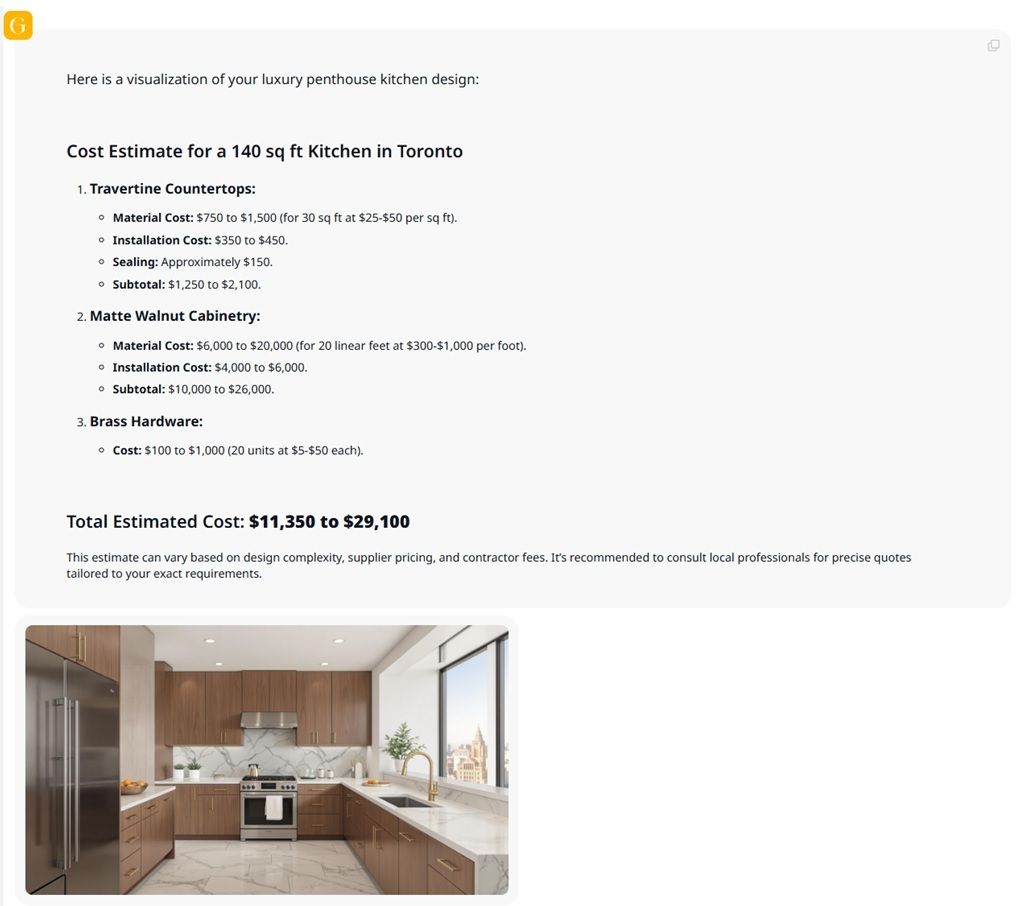
The penthouse sold that same week-even though the renovation wasn’t completed. The buyer committed because the design became financially transparent and visually undeniable.
This moment reflects a larger truth sweeping the industry: AI design turns hesitation into action.
For developers, design has always been tied to underwriting. But AI has shifted this from a static, one-time process to a dynamic, iterative decision engine.
Developers now use GRAI to:
1. Generate multiple design pathways with cost + ROI projections
Want to compare:
GRAI produces:
All in one interface.
2. Optimize layouts for saleability and rent premiums
In cities like Singapore, Tokyo, and Seoul-where every square foot is strategic-GRAI identifies:
Developers use this to enhance layouts before construction drawings begin.
3. De-risk cross-border investments
When developers enter foreign markets, local design preferences are often misunderstood.
GRAI solves this by delivering region-specific layouts and aesthetics, eliminating design misalignments that cause delays and cost overruns.
Architects aren’t being replaced by AI; they are being amplified by it. GRAI’s design generation isn’t meant to produce final drawings - it transforms the early-stage architectural workflow.
Architects use GRAI for:
Architects who adopt GRAI become faster, more data-driven, and more competitive.
Architects who don’t risk being outpaced-not by AI, but by peers who use it.
Agents have discovered that GRAI is more than a visualization tool. It is a conversion tool.
Agents use GRAI to:
A well-rendered, contextually accurate transformation can justify price points more effectively than any market comparables sheet.
Homeowners used to rely on moodboards, contractors, or decor intuition. Now they rely on GRAI.
They use it to:
GRAI transforms them into confident decision-makers.
There are many image AIs. There is only one real estate AI advisor
GRAI assesses:
This makes its design outputs not just beautiful images, but financially and contextually aware designs that can actually be built.
We are entering an era where:
This is not an aesthetic revolution. It is a financial one.
And GRAI is the operating system powering it.
If you’re a developer, designer, architect, agent, or homeowner, the competitive advantage is simple:
Use GRAI to generate:
Design no longer follows the deal. Design drives the deal.
Start using GRAI today and turn imagination into intelligent value: https://internationalreal.estate/chat


