Ask GRAI Anything
Your Real Estate Questions, Answered Instantly via Chat

Help us make GRAI even better by sharing your feature requests.

São Paulo is not simply Brazil’s largest city. It is the financial gravity center of Latin America. With more than 12 million residents and a metropolitan population exceeding 20 million, it hosts Brazil’s stock exchange, multinational headquarters, major banking institutions, and a fast-expanding technology sector.
When institutional capital moves in South America, it moves through São Paulo first.
That is why the São Paulo, Brazil real estate market in 2026 matters not only to domestic investors, but to global capital allocators seeking exposure to emerging market urban growth.
But this is no longer a market that rewards passive optimism. It rewards precision.
Structural Drivers Supporting the Market
Macro Variables Influencing 2026
Unlike speculative boom cycles of the past, São Paulo, Brazil real estate 2026 trends show a maturing market where micro-location performance matters more than broad headlines.
This is exactly where AI analysis becomes indispensable.
In 2025, prime districts such as Jardins and Itaim Bibi demonstrated remarkable resilience. While interest rate fluctuations tightened affordability in lower-income segments, high-net-worth and corporate-driven demand remained stable.
Commercial real estate told a more selective story:
The clear Takeaway: quality and location precision outperform broad market exposure.
GRAI’s Predictive Economic Forecasting Models Synthesize:
Instead of offering a single “prediction,” AI produces probability-weighted scenarios.
Base-Case Outlook for 2026
The São Paulo, Brazil real estate 2026 forecast suggests stability in prime zones, selective risk in oversupplied corridors, and increasing sophistication among investors.
One of the most searched queries is:
“What is the average house price in São Paulo, Brazil?”
The answer depends entirely on location and asset class.
In São Paulo, price per square meter can vary dramatically between:
The key investment mistake is assuming city-wide averages apply to micro - markets. They do not.
This is why AI-powered property valuation is critical. GRAI integrates comparable sales, demand signals, and micro-location data to deliver probability-backed valuation ranges - not generic averages.
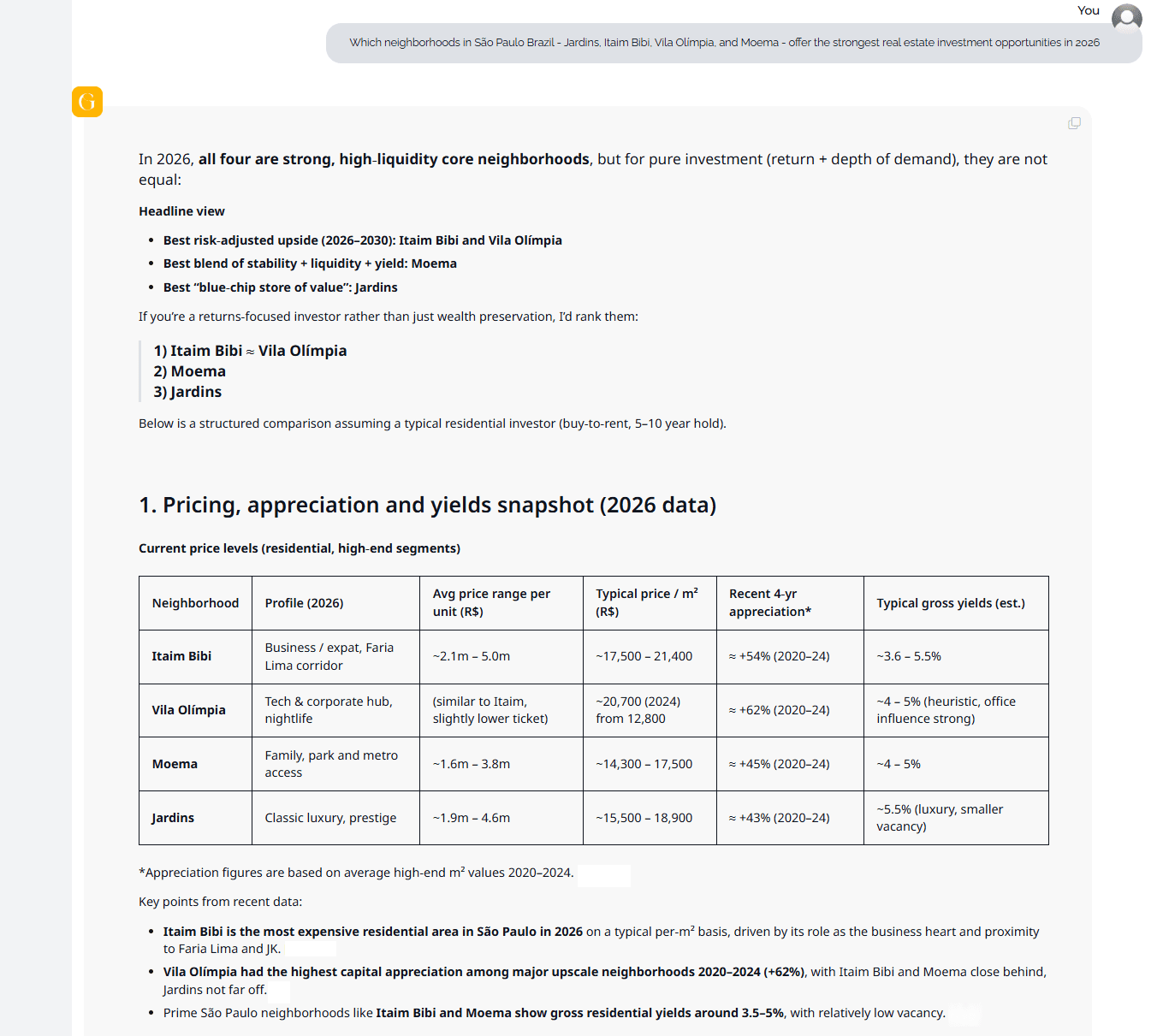
In 2026, all four neighborhoods - Jardins, Itaim Bibi, Vila Olímpia, and Moema - remain high-liquidity, core residential markets in São Paulo. However, when evaluated purely on return potential, capital appreciation, rental yield, and depth of demand, they are not equal.
For a returns-focused residential investor (5 -10year hold), the ranking is:
| Neighborhood | Avg Unit Price (R$) | Typical Price/m² (R$) | 4-Year Appreciation (2020–2024) | Typical Gross Yield |
|---|---|---|---|---|
| Itaim Bibi | ~R$2.1M - R$5.0M | ~R$17,500-21,400 | ≈ +54% | ~3.6-5.5% |
| Vila Olímpia | Slightly below Itaim (ticket size) | ~R$20,700 (2024 peak from ~12,800) | ≈ +62% | ~4-5% |
| Moema | ~R$1.6M - R$3.8M | ~R$14,300-17,500 | ≈ +45% | ~4-5% |
| Jardins | ~R$1.9M - R$4.6M | ~R$15,500-18,900 | ≈ +43% | ~3-5.5% (luxury-driven) |
Appreciation figures reflect average high-end m² values between 2020-2024.
Profile (2026): Financial district adjacency (Faria Lima corridor), strong expat demand.
Investment Thesis:
Itaim combines liquidity, tenant depth, and premium positioning. It is not the cheapest entry point, but it offers consistent absorption and institutional-grade resilience.
Best For: Investors prioritizing capital preservation with growth.

Profile (2026): Tech, corporate offices, nightlife, and younger professional demographic.
Investment Thesis:
Vila Olímpia delivered the highest capital growth in the last cycle. Its tech and office ecosystem continues to support rental demand.
Best For: Growth-oriented investors seeking stronger appreciation momentum.
Profile (2026): Family-oriented, park access (Ibirapuera proximity), metro connectivity.
Investment Thesis:
Moema offers one of the best risk-adjusted combinations of affordability, rental liquidity, and stability. It lacks Vila Olímpia’s growth surge but delivers dependable performance.
Best For: Investors seeking balance between yield and price growth.
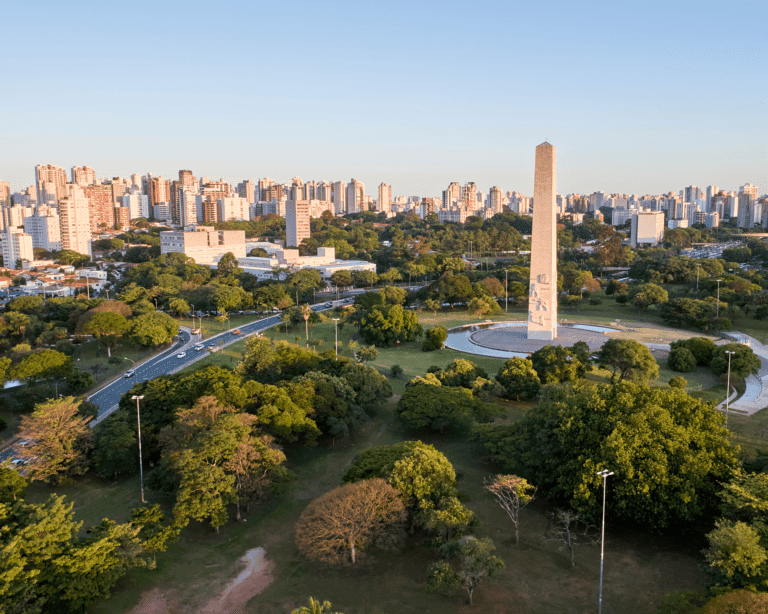
Profile (2026): Prestigious, low-density, traditional luxury enclave.
Investment Thesis:
Jardins functions as São Paulo’s blue-chip residential district. Growth is steadier rather than explosive.
Best For: Long-term capital preservation and luxury-focused buyers.
| Investment Goal | Best Neighborhood |
|---|---|
| Highest Recent Appreciation | Vila Olímpia |
| Strongest Liquidity & Institutional Appeal | Itaim Bibi |
| Best Risk-Adjusted Blend | Moema |
| Premium Wealth Preservation | Jardins |
All four remain core markets - but for pure return-focused investment between 2026 and 2030, Itaim Bibi and Vila Olímpia currently offer the strongest upside profile.
Advantages:
Advantages:
Risks:
In São Paulo, building bylaws and municipal compliance vary widely. Investors who fail to verify restrictions often face yield compression.
GRAI’s legal document review analyzes condominium regulations and flags rental restrictions instantly, eliminating compliance blind spots.
Run your São Paulo ROI scenario with GRAI: https://internationalreal.estate/chat
Yes. Foreign individuals are generally permitted to acquire urban property in São Paulo, subject to:
Restrictions typically apply to rural land or border zones. For international investors, the challenge is procedural clarity - not legal prohibition.
GRAI’s multilingual contract analysis and contextualization tools simplify cross-border property acquisition.
In prime districts, a 5% overpayment at acquisition can significantly reduce long-term ROI.
GRAI’s valuation engine integrates:
For investors repositioning older assets, GRAI’s AI-powered construction and interior cost estimation provides:
This converts renovation strategy from speculative to structured financial modeling.
The São Paulo, Brazil real estate market is resilient - but not immune to risk.
Key variables include:
AI-driven scenario modeling allows investors to simulate stress conditions before deploying capital.
Buy Signals
Hold Signals
Sell Signals
AI does not replace human judgment. It enhances it with probability-based clarity.
Get Real-Time São Paulo Market Intelligence: https://internationalreal.estate/chat
The era of generalized investing in São Paulo is narrowing.
In 2026, investors who outperform will:
GRAI is not a static research report. It is a real-time decision intelligence engine built for modern real estate investors.
Whether you are evaluating São Paulo, Brazil housing prices, exploring commercial real estate in Vila Olímpia, targeting luxury assets in Jardins, or investing internationally, the edge belongs to those using the most sophisticated intelligence available.
The market is competitive. Precision wins.
Start your São Paulo, Brazil Property Analysis with GRAI: https://internationalreal.estate/chat
Yes, São Paulo remains one of Latin America’s strongest urban real estate markets in 2026. Prime neighborhoods such as Jardins and Itaim Bibi continue to show structural demand from high-income buyers and corporate professionals. While broader market performance depends on interest rates and economic conditions, prime districts demonstrate resilience, liquidity, and long-term capital preservation potential. Investors who rely on AI-backed valuation and yield modeling gain a measurable advantage.
The average house price in São Paulo varies significantly by neighborhood and asset type. Luxury districts such as Jardins command a substantial premium per square meter compared to balanced residential areas like Moema. City-wide averages can be misleading because micro-location, building quality, and transit proximity strongly influence pricing. Investors should analyze neighborhood-level comparable sales rather than rely on general averages.
Rental yield performance depends on strategy and compliance. Corporate-driven districts such as Itaim Bibi and Vila Olímpia often show strong rental absorption due to executive and professional tenant demand. Moema typically offers steady, lower-volatility income. Short-term rental yields may be higher in specific buildings, but condominium regulations and local rules must be verified before projecting returns.
Yes. Foreign individuals are generally permitted to purchase urban property in São Paulo. The process involves tax registration, notarial documentation, and title verification. Restrictions usually apply to rural land or border areas, not central urban neighborhoods. International investors should conduct proper legal due diligence and verify currency and registration requirements before acquisition.
The São Paulo real estate forecast for 2026 suggests continued strength in prime residential zones, increasing yield-focused investing, and widening performance gaps between Grade-A and secondary commercial properties. Interest rate movements and inflation trends remain important variables. Investors who analyze micro-location data, rental absorption, and economic indicators are better positioned to make informed buy, hold, or sell decisions.


