Ask GRAI Anything
Your Real Estate Questions, Answered Instantly via Chat

Help us make GRAI even better by sharing your feature requests.
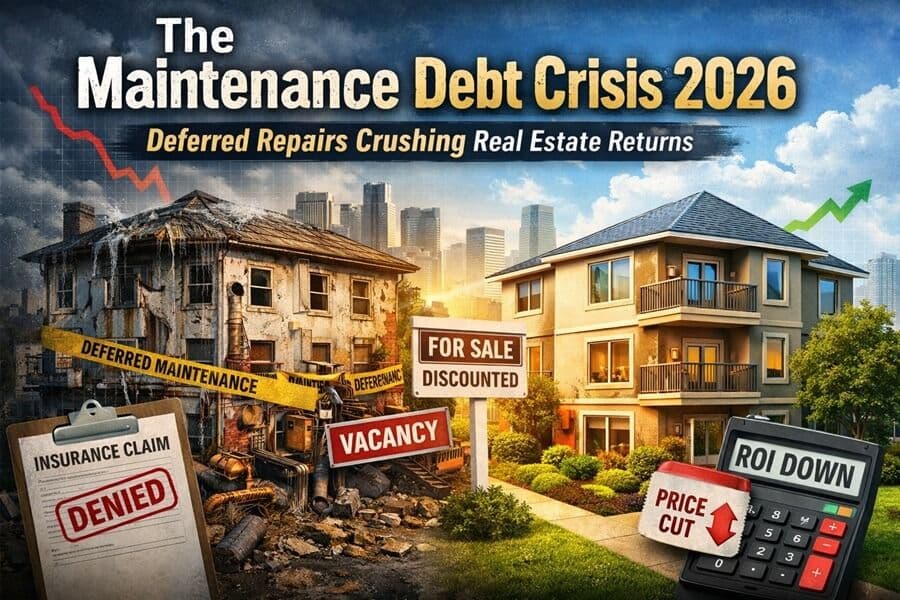
Maintenance debt is the gap between what a property needs to stay healthy and what the owner has funded. In 2026, it is a bigger return killer than many rate moves because it hits rent power, vacancy, insurance risk, lender underwriting, and resale liquidity all at once. This guide shows the compounding mechanics of deferred maintenance, the specific systems that matter most, how to spot maintenance debt quickly, and the investor playbook to turn a “tired property” into a resilient cashflow asset. It also includes GRAI prompts that let you create a capex plan, stress test cashflow, and compare properties on true risk adjusted returns.
Maintenance debt is not cosmetic. It is infrastructure.
It is the unpaid balance of necessary upkeep and replacement across the systems that keep a building safe, functional, insurable, and financeable.
Typical categories:
Roof, gutters, flashing, waterproofing
Building envelope, exterior paint, sealants, windows, balcony membranes
HVAC systems, ducting, ventilation, controls
Plumbing supply and drain lines, water pressure, leak risk
Electrical panels and wiring, load capacity, safety compliance
Foundation drainage, grading, retaining walls, moisture control
Fire and life safety systems, alarms, sprinklers, egress
The reason it is “debt” is that you will pay later, and you rarely pay the sticker price. You pay:
Replacement cost
Collateral damage cost
Vacancy cost
Reputation cost
Financing cost
Resale discount cost
Rate hikes are visible and incremental. Maintenance debt is invisible and nonlinear.
A 0.5% to 1.0% mortgage rate move usually changes:
The monthly payment
The buyer pool
The cap rate environment
Deferred maintenance becomes tenant experience.
What tenants feel:
Humidity and mold risk
Unreliable cooling or heating
Water pressure problems
Pests due to envelope issues
Noise and inefficiency due to aging systems
What landlords see:
Higher turnover
Longer vacancy
More concessions
More negative reviews in short stay models
More “good tenants” leaving first
Even when the market is strong, your net rent can underperform because you are paying an invisible discount to compensate for a tired asset.
The most expensive repairs hit when you are least prepared:
Right after closing
During a weak leasing period
When you need to refinance
When insurance is tightening
During a market slowdown
This is how owners get trapped:
They cut corners, which accelerates deterioration
They borrow expensively, which compresses returns
They sell into a soft market, which locks in a discount
In 2026 underwriting, lenders care about:
Roof life
HVAC life
Deferred capex backlog
Insurance and claims history
HOA reserves for condos
Inspection outcomes and compliance
When maintenance debt is visible, three things happen:
Appraisals go conservative
Loan proceeds shrink
The buyer pool narrows
The “market price” becomes irrelevant. The clearing price becomes “what a cautious buyer will accept.”
That is why maintenance debt is a liquidity killer.
Deferred maintenance increases the probability and severity of:
Water intrusion claims
Mold remediation
Electrical risk events
Storm damage amplification due to weak envelope
Insurance is increasingly sensitive to:
Building condition
Claims history
Risk area exposure
The cost impact shows up as:
Higher premiums
Higher deductibles
Coverage exclusions
Longer underwriting cycles
All of those compress net yield and reduce buyer demand.
Real estate wins are often made by optionality:
Refinance into a better rate
Sell into a hot quarter
Hold through a slow year
Reposition the asset
Maintenance debt removes optionality because you are forced into actions at the worst time.
Turn deferred repairs into smarter real estate decisions with GRAI : https://internationalreal.estate/chat
Most sales are triggered by life events, not perfect timing.
If you sell under time pressure, you do not get to “fix it later.”
A roof can “work” until it fails. HVAC can “work” until the heat wave. Plumbing can “work” until the leak destroys a unit.
Function is not health.
Good tenants care the most, and they leave first.
The tenant who stays is often the tenant you do not want.
If you are screening a property, this quick checklist catches most problems.
Roof age, visible wear, missing shingles, membrane bubbling
Gutters, downspouts, water marks, staining
Flashing, penetrations, skylights, chimneys
Grading, drainage, standing water after rain
Foundation cracks, efflorescence, moisture smell
Window seals and exterior caulking quality
HVAC age and service history, consistent maintenance proof
Electrical panel brand and condition, signs of overheating
Plumbing supply lines, corrosion, leaks, water pressure issues
Water heater age and installation quality
Evidence of unpermitted work
Ask for a 3 year maintenance log
Ask for last major replacements and receipts
If the owner cannot answer roof and HVAC age, assume maintenance debt exists
Most owners fix what looks good. Professionals fix what protects the asset.
A practical triage sequence that protects value fastest:
Water intrusion and drainage
Roof and building envelope
Electrical safety and major plumbing risk
HVAC reliability and ventilation
Windows and seals where energy and moisture loss is high
Interiors, kitchens, flooring, paint, only after systems are stable
Cosmetics before water is how investors burn money twice.
A capex plan is not a maintenance budget line. It is a calendar.
Your capex plan should include:
Expected remaining useful life of major systems
Replacement costs with inflation buffers
Priority ranking by risk to habitability and value
Reserve contributions per month
A good rule is:
Treat reserves as non negotiable, like a mortgage payment
If you cannot reserve, you cannot afford the asset
Many “deals” in 2026 are actually:
Deferred maintenance plus seller fatigue
A roof and HVAC problem disguised as a discount
Insurance friction waiting to happen
A smart 2026 buyer does three things:
Gets inspection quality that focuses on systems, not cosmetics
Negotiates based on replacement timelines, not vague repair lists
Models a stress case where one major capex hits in year 1
If the deal still works under stress, it is real.
Stress test maintenance debt and capex faster with GRAI : https://internationalreal.estate/chat
Maintenance debt is tenant churn.
A well maintained property:
Attracts better tenants
Reduces turnover
Reduces vacancy loss
Supports rent increases with less pushback
Reduces operational chaos
In a flat market, retention becomes profit.
Maintenance debt is a systems problem, which makes it perfect for real estate AI.
Use GRAI as a repeatable workflow:
Translate inspection notes into priorities
Build a capex calendar
Model cashflow under repair scenarios
Compare properties on true risk adjusted returns
“Create a 5 year capex plan for this property using roof, HVAC, plumbing, and envelope age, then suggest a monthly reserve target.”
“Given these inspection notes, rank repairs by risk to value and habitability, and estimate the cost and consequence of delaying each by 12 months.”
“Model my rental cashflow including realistic maintenance reserves and one major capex event, show worst case monthly cashflow and required buffer.”
“Compare two properties, one has higher rent but older systems, the other has lower rent but newer systems, which has better risk adjusted returns and why.”
Try it here: https://internationalreal.estate/
Maintenance debt is the backlog of repairs, replacements, and system upgrades a property needs but the owner has delayed funding. It usually affects roofs, HVAC, plumbing, electrical systems, drainage, and the building envelope, and it can reduce rent, increase vacancy, and lower resale value.
Rate hikes usually affect returns in a visible and gradual way through higher financing costs. Deferred maintenance is more damaging because it can hit multiple areas at once, including tenant retention, insurance premiums, vacancy, emergency repair costs, financing terms, and resale discounts.
Investors should check roof age, HVAC condition, plumbing and electrical systems, water intrusion signs, grading, foundation moisture, and maintenance records from the past 3 years. If the seller cannot clearly explain the age and replacement history of major systems, maintenance debt is likely present.
The first priority should always be water intrusion and structural protection, including roof issues, drainage, flashing, and building envelope weaknesses. After that, owners should address electrical safety, major plumbing risks, HVAC reliability, and ventilation before spending on cosmetic upgrades.
GRAI helps investors turn inspection notes into a 5-year capex plan, rank repairs by urgency, model repair-delay scenarios, estimate reserve needs, and compare properties based on true risk-adjusted returns instead of headline rent alone.
In 2026, the biggest threat to returns is not always rates. It is deferred maintenance that compounds into vacancy, insurance friction, lender pushback, and resale discounts.
If you want to win in real estate, treat maintenance like a balance sheet, not like a repair list. Pay down maintenance debt early, build reserves, and buy assets with systems you can defend. That is how you protect liquidity and compound returns.


