Ask GRAI Anything
Your Real Estate Questions, Answered Instantly via Chat

Help us make GRAI even better by sharing your feature requests.
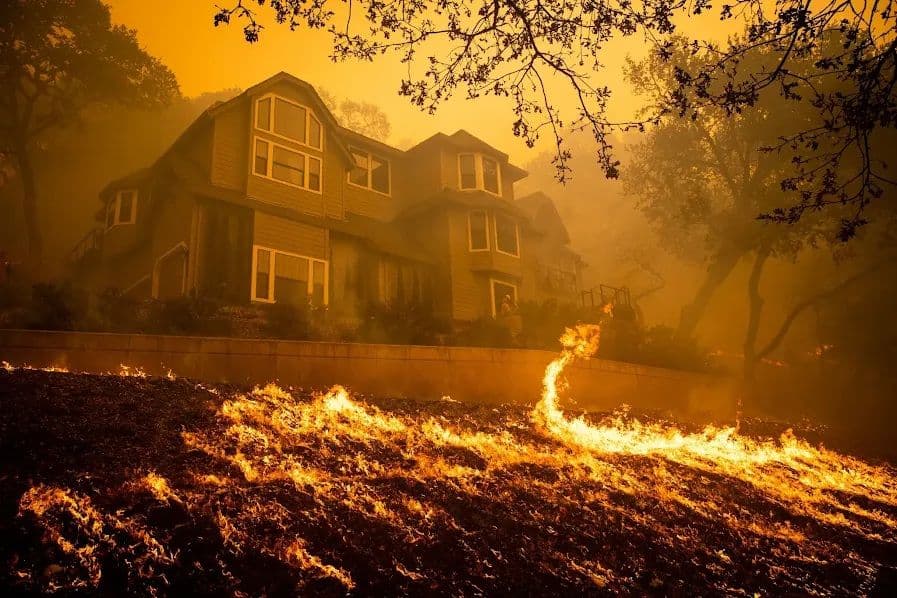
Home insurance used to be the quiet part of a real estate deal. You checked a box, paid a few hundred dollars a year and moved on. That world is gone.
In 2025, climate fuelled disasters, surging repair costs and reinsurance price hikes are turning home insurance into a central force in the US housing market. Premiums are rising, coverage is shrinking in high risk zones, and state backstop programs are carrying more weight than ever.
For homeowners, small landlords and institutional investors, this is no longer a story you can ignore. Insurance availability and pricing now sit next to interest rates and rent growth as core underwriting variables.
GRAI enables you to quantify risk at the property and portfolio level instead of responding to headlines after the fact.
Several independent data sets show the same pattern. The cost of insuring a home in the United States has risen sharply in just a few years.
A May 2025 analysis based on National Association of Insurance Commissioners data reported that the average homeowners insurance premium rose 11.2% in 2022 compared with 2021.
By 2025, Bankrate’s “True Cost of Home Insurance” report calculated that the national average annual premium had reached $2,470, up 9% since 2023.
NerdWallet’s 2025 review placed the average annual premium at about $2,110 for a standard policy on a $300,000 dwelling, highlighting how methodology and coverage levels affect reported averages but still point to a clear upward trend.
At the same time, some homeowners are dropping coverage altogether. A mid 2024 market report found that roughly 6 million US homeowners had no home insurance, with affordability and reduced policy choices cited as key drivers.
From GRAI’s perspective, that statistic is as important as the average premium. It means that in some markets, insurability and coverage quality are now binary constraints, not just a matter of price.
Behind these premium increases lies a series of costly disasters and changing risk models.
Swiss Re estimated that insured losses from natural catastrophes would reach about $107 billion in 2025, up from $137 billion in 2024, keeping annual losses near record highs.
A 2024 analysis from the Joint Economic Committee Democrats noted that structural replacement costs associated with homeowners insurance rose 55% between 2020 and 2022 and that reinsurers raised prices on insurers by 37% in 2023, in part to account for higher climate risks.
Think tank work in 2025 underlined that climate change is driving more frequent and severe events and that catastrophe models used by insurers and reinsurers are increasingly forward looking. As these models reveal that prior pricing underestimated risk, premiums will continue to rise.
For investors, that means higher premiums are not a temporary blip. They reflect a re rating of risk and a repricing of both insurance and reinsurance capital.
The insurance crunch is strongest in specific states and hazard zones.
California illustrates the wildfire side of the crisis.
By September 2024, Bankrate reported that seven of the twelve largest home insurers in California had either paused or heavily restricted new homeowners policies. The list included State Farm, Allstate, Farmers, USAA, Travelers, Nationwide and Chubb.
Several carriers have also increased non renewals in high wildfire risk areas, particularly in parts of Southern California such as Pacific Palisades and Altadena.
A December 2024 analysis showed that annual premiums in some California counties had risen more than 150% over the last decade, with Mariposa County premiums more than doubling to around $3,700 a year.
As private coverage contracts, more homeowners are turning to the California FAIR Plan, the state’s insurer of last resort. A recent Reuters explainer noted that FAIR plans rely on assessments of private insurers when losses exceed reserves, and private carriers in turn pass those costs to policyholders through higher premiums. That feedback loop encourages some insurers to exit altogether, which further concentrates risk in the residual market.
Florida presents the hurricane driven version.
A 2025 Yale Law Journal essay reported that Florida home insurance rates are about four times the US national average and are still rising.
In Florida, home insurance rates are largely deregulated and catastrophe models plus reinsurance costs are explicitly reflected in premiums. The state has also created taxpayer backed reinsurance programs and relies heavily on Citizens Property Insurance Corporation, its residual market insurer.
Frontier Group’s 2025 report documented that insurers have non renewed increasing numbers of policies in both California and Florida and that more than 100,000 Florida homeowners were left struggling to secure full coverage as private insurers withdrew.
Citizens has become the largest homeowners insurer in the state and is seeking premium increases in the teens for 2025 to keep pace with risk and reinsurance costs, according to S&P Global analysis.
Quantify Disaster Exposure - Model it with GRAI: https://internationalreal.estate/chat
States such as Louisiana, Nebraska, Colorado and Texas are also experiencing rapid premium growth as hail, tornado and flood risks are re rated, even if the withdrawal of insurers has not reached California or Florida levels.
For GRAI users, this means that insurance risk should now be treated as a state and county specific input, not a generic national assumption.
Home insurance sits at the intersection of hazard risk, mortgage finance and household budgets.
Policy and research organizations are beginning to map these connections more explicitly.
A 2025 report from the Center for American Progress warned that insurers are responding to heightened losses by reducing coverage, exiting high risk markets and dramatically raising premiums, which threatens the availability of affordable and safe housing.
A 2025 article from New America on Florida noted that climate driven hazards combined with rapid coastal growth are likely to create enormous consequences for the state’s housing and homeowners insurance markets and that housing affordability and stability are already under pressure.
Frontier Group highlighted that some homeowners cannot obtain coverage at all or can only access limited FAIR Plan policies, leaving them exposed to catastrophic loss and complicating mortgage financing.
In practice, rising premiums and shrinking availability affect:
Buyer pools, because lenders generally require adequate coverage as a condition of mortgage approval
Net operating income, as higher premiums and deductibles eat into landlord returns
Appraisals and valuations, especially in markets where premium increases are concentrated in specific hazard zones
Long term regional growth, as households and businesses reconsider the trade off between location benefits and insurance cost
GRAI incorporates these factors when users ask for total cost of ownership or long horizon investment scenarios in high risk markets.
Traditional affordability calculations often focus on mortgage principal and interest, property taxes and basic maintenance. In the current environment that is not enough.
A realistic total cost of ownership model needs:
Current premium levels for the specific address, not just state averages
Reasonable assumptions for premium growth over time, which may be much higher than general inflation in high risk zones
Deductible structures, including separate hurricane or wind deductibles expressed as a percentage of dwelling value in some states
Potential surcharges or assessments from residual market plans in the event of large disasters
For example, a Florida coastal property with a seemingly manageable premium today could face:
Annual premium increases well above 10% in some scenarios
A hurricane deductible of 2% to 5% of insured value, creating a large cash exposure in a major event
Additional assessments if Citizens or another residual plan faces shortfalls after a catastrophe
GRAI can incorporate these insurance trajectories directly into cash flow projections rather than treating them as static.
From an investment standpoint, the insurance crunch suggests several shifts in strategy.
More granular location selection
Investors need zip code or even block level hazard and insurance data, not just state averages. Two neighborhoods in the same metro can have very different insurance profiles.
Preference for resilient construction
Newer homes with stronger roofs, modern building codes and lower insurance premiums may be more attractive than older homes in the same area, even if the older stock seems cheaper. Data shows that average annual premiums for homes built in 2024 are around $1,611, more than $900 lower than for homes built in 1980.
Greater attention to state backstop programs
Heavy dependence on FAIR Plans or Citizens can signal both availability risk and the potential for future assessments. Investors should understand how these mechanisms are funded in each state.
Scenario based underwriting
Underwriting should now include scenarios where premiums rise 10% to 20% annually for several years in higher risk zones and where insurers non renew at short notice, forcing a scramble for expensive backup policies.
GRAI can encode these practices so that users who are not insurance experts still receive underwritten views that reflect the new reality.
GRAI, the world’s smartest real estate AI advisor, is positioned to help across three levels of analysis: single property, portfolio and design.
Prompts you might use:
For this address, estimate current home insurance cost ranges based on state and hazard profile, model scenarios with 5%, 10% and 20% annual premium growth over the next 10 years, and show how that affects my total cost of ownership.
Compare buying this coastal or wildfire zone property with a similar priced property in a lower risk inland market, including differences in insurance premiums, deductibles and lender requirements.
For small landlords or institutions:
Take this list of properties in my portfolio and identify which are most exposed to insurance risk based on state, hazard type and premium trends, then rank them by vulnerability of net operating income.
Model how my portfolio cash flow and cap rate valuation change under different insurance scenarios, including increased use of FAIR Plan or Citizens coverage and higher deductibles.
Insurance is not only about location. It can be influenced by construction and mitigation.
For this property in a fire or wind exposed area, suggest building or retrofit measures that are likely to improve insurance terms, such as roof upgrades, defensible space, flood vents or elevation changes, and estimate rough cost bands alongside typical premium credits where available.
Generate alternative design schemes for a new build in a hazard exposed region that balance resilience, insurability and construction cost, and compare their impact on projected insurance premiums.
By integrating these outputs, GRAI gives users a decision framework that treats insurance as a first order input, not an afterthought.
Stress-Test Your Property - Run Insurance Scenarios in GRAI: https://internationalreal.estate/chat
The US home insurance market in 2025 to 2026 is a stress test for the idea that you can price climate risk only with historical data and treat insurance as a stable commodity.
Premiums are rising. Coverage is shrinking in the highest risk zones. State backstops are carrying more load, and millions of homeowners are either underinsured or uninsured.
For serious buyers and investors, the response has to go beyond anxiety. It requires explicit modeling of insurance costs, careful attention to local hazard and regulatory conditions and a willingness to adjust location and product choices accordingly.
GRAI’s purpose is to make that level of analysis available to everyone, not only to institutional desks. When you ask GRAI to model a property or a portfolio in a coastal, flood or wildfire prone area, you are no longer guessing at insurance risk. You are seeing it laid out in numbers and scenarios that you can act on.


