Ask GRAI Anything
Your Real Estate Questions, Answered Instantly via Chat

Help us make GRAI even better by sharing your feature requests.

For property investors, rental yield can be one of the clearest ways to compare Abu Dhabi's residential markets-but it should never be viewed in isolation.
A neighbourhood offering a high headline yield may carry higher vacancy risk, weaker resale liquidity, elevated service charges or substantial future supply. Conversely, a premium location with a lower gross yield may offer stronger tenant demand, better asset quality and greater long-term liquidity.
That makes where you buy just as important as what you buy.
Abu Dhabi's residential market includes established apartment communities, waterfront developments, family-oriented villa districts and newer master-planned destinations. For investors participating in the international real estate market, understanding these differences is essential before comparing rental returns. Investors looking for a broader overview of the market can explore our Abu Dhabi investment guide before comparing individual neighbourhoods.
This guide examines the best Abu Dhabi neighbourhoods for rental yield, what drives rental demand in each location, and which risks investors should investigate before purchasing.
Important: Rental yields and property prices can change with market conditions, property type, building quality and transaction timing. Investors should verify current transaction and rental data before making an investment decision.
A high rental yield does not automatically make a neighbourhood a good investment.
A stronger rental market generally combines several factors:
Sustainable tenant demand
Reasonable acquisition prices
Competitive rental rates
Low or manageable vacancy
Good transport connectivity
Access to employment centres
Schools and healthcare
Retail and lifestyle amenities
Controlled future supply
Reasonable service charges
Adequate resale liquidity
For international investors, there is another consideration: how easily the property can be managed from overseas.
A property that produces an attractive gross yield but requires frequent maintenance or experiences prolonged vacancies may generate weaker net returns than initially expected.
The following neighbourhoods are worth considering when researching Abu Dhabi rental property:
| Neighbourhood | Property Type | Typical Tenant Profile | Rental Strategy | Main Consideration |
|---|---|---|---|---|
| Al Reem Island | Apartments | Professionals, couples, families | Income-focused | Building-level variation |
| Yas Island | Apartments, villas | Families, professionals, lifestyle tenants | Income + growth | New supply |
| Al Raha Beach | Apartments, villas | Professionals, families | Long-term rental | Service charges |
| Al Reef | Apartments, villas | Value-focused families | Yield-focused | Appreciation may vary |
| Saadiyat Island | Luxury apartments, villas | Affluent tenants | Premium rental | High entry price |
| Masdar City | Apartments | Professionals, students, sustainability-focused tenants | Emerging income | Developing market |
| Khalifa City | Villas | Families | Long-term rental | Different liquidity profile |
The table should be treated as a starting framework rather than a ranking. The best neighbourhood depends on the investor's budget, target tenant, financing structure and expected holding period.
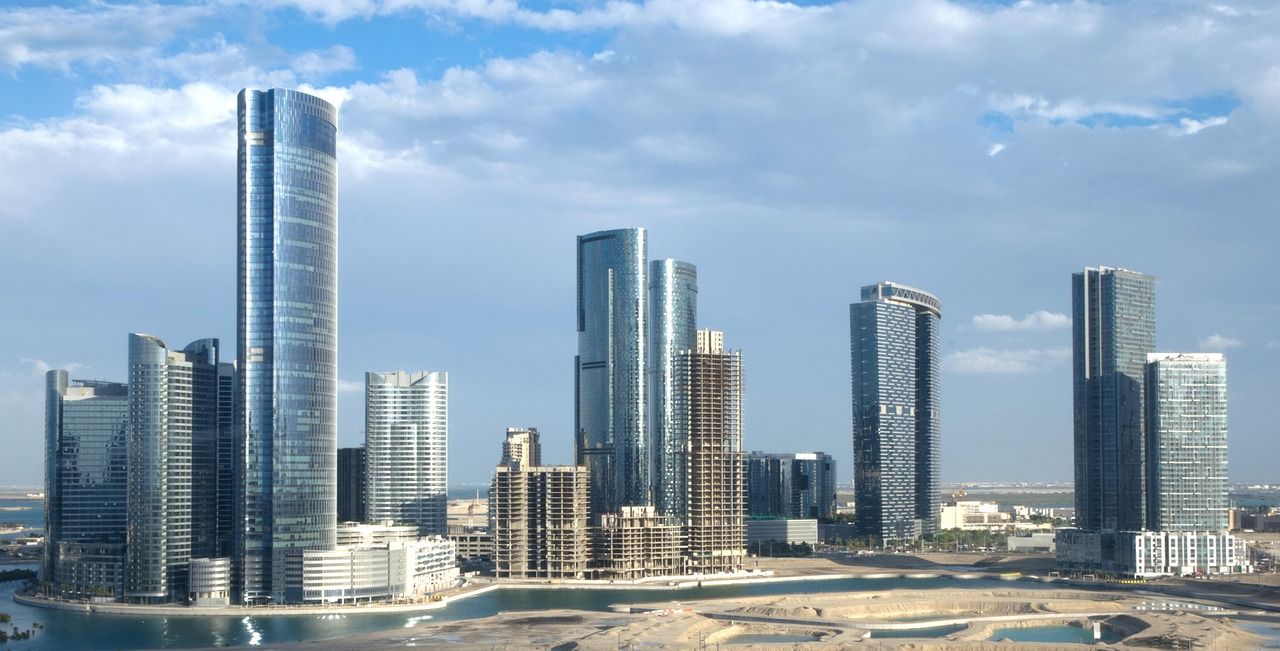
Al Reem Island is one of the most prominent apartment markets in Abu Dhabi.
Its proximity to central Abu Dhabi, modern residential towers and broad range of apartments makes it particularly relevant for investors focused on rental income.
The tenant base includes:
Young professionals
Couples
Families
Corporate employees
Long-term expatriate residents
For investors, the attraction is the depth of the apartment market. There are multiple property sizes and price points, allowing investors to compare different entry strategies.
Al Reem Island can be attractive to yield-focused investors because apartment acquisition prices can be more accessible than premium waterfront markets.
However, investors should avoid using an island-wide rental yield as their primary decision metric.
A better analysis compares:
Building → Unit → Purchase Price → Achievable Rent → Operating Costs → Net Yield
Two apartments in the same neighbourhood can have very different investment outcomes because of differences in:
Building age
Floor
View
Amenities
Service charges
Maintenance
Unit layout
Developer reputation
Building-level variation.
The neighbourhood may have strong rental demand overall, but individual buildings can perform very differently.
Yas Island combines residential property with tourism, entertainment, retail and lifestyle infrastructure.
That makes it particularly interesting for investors seeking a combination of rental income and long-term capital appreciation potential.
Residential options include:
Apartments
Townhouses
Villas
Branded residences
The tenant base can include:
Professionals
Families
Lifestyle-focused residents
Corporate tenants
International residents
The neighbourhood's entertainment and leisure ecosystem can also strengthen its appeal beyond purely residential considerations.
Investors should distinguish between:
High rental demand and high rental yield.
A premium property can attract strong tenants but still produce a lower yield because its acquisition price is high.
For Yas Island, investors should therefore calculate both:
Gross rental yield
Net rental yield
New supply.
The continued development of the area can create additional competition for existing properties.

Al Raha Beach offers a waterfront residential environment with apartments and villas.
Its tenant base is supported by professionals and families looking for modern homes with access to major parts of Abu Dhabi.
The area provides a balance between:
Waterfront living
Residential amenities
Accessibility
Family appeal
Established infrastructure
For long-term rental investors, these characteristics can support relatively stable tenant demand.
Before purchasing, investigate:
Building service charges
Recent rental transactions
Vacancy levels
Maintenance standards
Competing inventory
Comparable purchase prices
The headline rental yield should always be adjusted for ownership expenses.
Operating costs.
Waterfront developments with extensive amenities may have higher service charges, which can reduce net rental returns.
Al Reef is particularly relevant to investors looking for relatively accessible residential property.
The community includes apartments and villas and has a strong family-oriented character.
Lower acquisition prices can potentially create stronger gross rental yields than premium neighbourhoods.
This makes Al Reef worth considering for investors whose primary objective is rental income rather than luxury positioning.
Demand can come from:
Families
Professionals
Value-conscious tenants
Long-term residents
Capital appreciation may differ from premium locations.
A property that produces attractive rental income is not necessarily the strongest capital-growth investment.
Investors should decide whether their priority is:
Income → Growth → Liquidity
before selecting the neighbourhood.
Saadiyat Island occupies a different position within Abu Dhabi's residential market.
It is primarily associated with luxury housing, cultural attractions, beaches and premium residential developments.
The area can appeal to:
Affluent tenants
Luxury buyers
International investors
Executive households
Long-term owner-occupiers
Premium locations can offer strong asset-quality characteristics, but the higher purchase price can compress rental yields.
This creates an important investment distinction.
An investor seeking the highest rental yield may prefer a more affordable apartment market.
An investor prioritising premium positioning and long-term asset quality may accept a lower initial yield.
Neither strategy is necessarily superior.
Use GRAI to compare Abu Dhabi neighbourhoods on yield, asset quality, and liquidity - before you commit capital: https://internationalreal.estate/chat
High entry price.
Investors should ensure that expected rental income justifies the acquisition price.

Masdar City represents a newer type of Abu Dhabi residential investment market.
Its sustainability-focused positioning and proximity to education, technology and business activity give it a distinct tenant proposition.
Potential investment drivers include:
Modern residential developments
Sustainability positioning
Technology-focused ecosystem
Proximity to educational institutions
Emerging rental demand
Because the market continues to develop, investors should place greater emphasis on current tenant demand rather than relying entirely on future growth projections.
Market maturity.
Emerging communities can offer upside, but rental demand and resale liquidity may be less predictable than in established locations.
Khalifa City differs from Abu Dhabi's high-rise investment markets.
The neighbourhood is more strongly associated with:
Villas
Family housing
Schools
Healthcare
Local amenities
This creates a different rental strategy.
Instead of focusing on studio and one-bedroom apartment yields, investors may target larger family properties with longer expected tenancy periods.
Different liquidity profile.
Villa investments may have a narrower buyer pool than smaller apartments, potentially affecting resale speed.
There is no single answer.
The highest rental yield can change depending on:
Property type
Purchase price
Building
Unit size
Rental strategy
Financing
Service charges
Vacancy
Maintenance costs
An investor comparing a studio in Al Reem Island with a luxury apartment in Saadiyat Island is not comparing equivalent assets.
The more useful question is:
Which Abu Dhabi neighbourhood offers the best risk-adjusted rental return for my investment strategy?
That question changes the analysis from simple yield hunting to investment underwriting.
One of the most important distinctions for Abu Dhabi property investors is the difference between gross and net rental yield.
The basic formula is:
Annual Rental Income ÷ Property Purchase Price × 100
For example, if a property costs AED 1 million and generates AED 70,000 in annual rent:
AED 70,000 ÷ AED 1,000,000 × 100 = 7% gross yield
But the investor does not necessarily keep AED 70,000.
Net yield considers expenses such as:
Service charges
Maintenance
Property management
Insurance
Vacancy
Financing costs where relevant
This can materially change the investment picture.
A property advertised with a 7% gross yield could produce a substantially lower return after operating expenses.
This is why investors should compare net cash flow, not simply marketing yields.
A useful investment comparison should evaluate at least seven variables.
Is the asking price supported by recent comparable transactions?
What rent could realistically be achieved-not the highest advertised rent?
How much downtime should be assumed between tenants?
What percentage of gross rent is absorbed by recurring property costs?
How does borrowing affect monthly cash flow and overall return?
Could new projects increase rental competition?
How easy could it be to sell the property when the investment strategy changes?
This framework can help investors avoid choosing a property solely because it displays the highest headline yield.
Investors increasingly have access to AI tools that can help organise property information and test investment assumptions.
GRAI, an AI real estate intelligence platform, can help investors analyse property opportunities by bringing together information such as:
Purchase price
Rental assumptions
Property expenses
Financing scenarios
Comparable properties
Investment risks
Potential ROI
Downside scenarios
Instead of asking simply, "What is the rental yield?", investors can use AI-assisted analysis to ask:
"What happens to my return if rent is 10% lower, vacancy increases and service charges rise?"
That distinction is important because real estate investment is ultimately about risk-adjusted returns, not headline numbers.
Ask GRAI to stress-test your Abu Dhabi rental assumptions across rent, vacancy, and service charges in seconds: https://internationalreal.estate/chat
Agents advising Abu Dhabi property investors can use GRAI Branded Deal Reports to turn property analysis into professional, investor-ready reports.
A report can help present rental assumptions, ROI scenarios, comparable evidence and investment risks in a structured format that agents can share with clients during property consultations.
For investor-facing agents, this can make the transition from property listing → investment analysis → client recommendation more transparent and easier to communicate.
Investors and agents can use prompts such as these to investigate rental opportunities.
Compare Al Reem Island, Yas Island, Al Raha Beach and Al Reef for a rental investment. Evaluate purchase price, achievable rent, gross yield, estimated net yield, tenant demand, future supply and resale liquidity.
Analyse this Abu Dhabi property using the listing, purchase price, expected rent, service charges and payment plan I provide. Calculate gross and estimated net rental yield and identify the key risks.
Model this Abu Dhabi rental investment under base, optimistic and downside scenarios. Reduce rental income, increase vacancy and operating costs, and show how each assumption affects annual cash flow and ROI.
AI analysis should complement-not replace-professional valuation, legal, financial and regulatory advice.
Evaluate any Abu Dhabi rental deal with GRAI - from yield and cash flow to exit liquidity risk: https://internationalreal.estate/chat
Investors following international real estate news should avoid making Abu Dhabi investment decisions based solely on broad market headlines.
A rising city-wide market does not guarantee that every neighbourhood or building will outperform.
The most important signals are often more local:
Rental demand
New supply
Transaction activity
Price-to-rent ratios
Tenant demographics
Development quality
Service charges
Financing conditions
This is particularly important for investors comparing Abu Dhabi with Dubai, Riyadh, Doha, Singapore or other markets within the broader international real estate market.
There is no universally best neighbourhood. Al Reem Island, Al Reef, Yas Island and Al Raha Beach can each appeal to different rental strategies. Investors should compare net yield, tenant demand, service charges, future supply and resale liquidity.
Abu Dhabi can offer attractive opportunities for rental investors, but returns depend on property selection, purchase price, achievable rent, operating costs and market conditions.
Al Reem Island is an important apartment market with a broad tenant base. However, building-level differences mean investors should assess individual properties rather than relying on neighbourhood-wide averages.
Not necessarily. A higher gross yield can be offset by high service charges, maintenance, vacancy, weaker resale liquidity or greater supply risk. Net, risk-adjusted return is a more useful measure.
GRAI can help investors and agents organise property information, compare rental assumptions, model ROI and cash flow scenarios, identify risks and stress-test investment assumptions. Its analysis should complement professional due diligence rather than replace it.
Agents can use GRAI Branded Deal Reports to present rental projections, ROI scenarios, comparable evidence, assumptions and risk factors in a structured, investor-ready format for property consultations and client discussions.
The best Abu Dhabi neighbourhood for rental yield depends on what the investor is trying to achieve.
Al Reem Island may appeal to investors seeking apartment-based rental exposure and a broad tenant pool. Yas Island offers a lifestyle-led market with potential income and growth characteristics. Al Raha Beach combines waterfront living with family and professional demand, while Al Reef may appeal to investors prioritising rental income and lower entry costs.
Saadiyat Island sits toward the premium end of the market, where asset quality and long-term positioning may matter more than maximizing headline yield. Masdar City offers exposure to an emerging community, while Khalifa City provides a family-oriented villa investment profile.
The important point is that rental yield should be the beginning of the analysis, not the end.
Investors should calculate net returns, examine future supply, stress-test assumptions and consider liquidity before committing capital. For international buyers, these checks become even more important because property management, financing, currency exposure and distance from the asset can introduce additional risks.
For agents and investors looking to make this process more structured, GRAI can help analyse property opportunities, compare scenarios and turn complex investment information into actionable insights. GRAI Branded Deal Reports can also help agents present those findings in a professional format when advising investor clients.


