Ask GRAI Anything
Your Real Estate Questions, Answered Instantly via Chat

Help us make GRAI even better by sharing your feature requests.
GRAI is moving real estate AI beyond search, summaries, and static answers.
A user can now start with a plain language brief and generate a contextual spatial concept, often including a floor plan, interior direction, exterior direction, and an investment-oriented starting point for review. These outputs are not permit-ready drawings, and they should not be treated as technical documents. But they are highly valuable for one reason: they compress the time, effort, and cost required to get from idea to visual concept.
That is the real unlock.
Instead of waiting for the first interpretation of a brief to arrive through a slow chain of back and forth, users can now create an instant visual hypothesis, critique it, refine it, and connect it to feasibility thinking much earlier. For developers, investors, operators, and design-led teams, that means faster decisions, tighter feedback loops, and a much lower cost of contextual visualization at the earliest stage of a project.
For a while, most real estate AI tools focused on information retrieval. They could summarize listings, scan documents, surface market signals, or answer narrow questions. Useful, yes. But still one step removed from action.
The next stage is different. It turns real estate intent into something spatial.
That is where GRAI is beginning to stand apart.
Rather than stopping at “Here is the answer,” the platform responds with “Here is a concept you can react to.” That changes the nature of the interaction. The user is no longer limited to text, numbers, or generic visual inspiration. They get an asset-specific visual direction that can be discussed immediately.
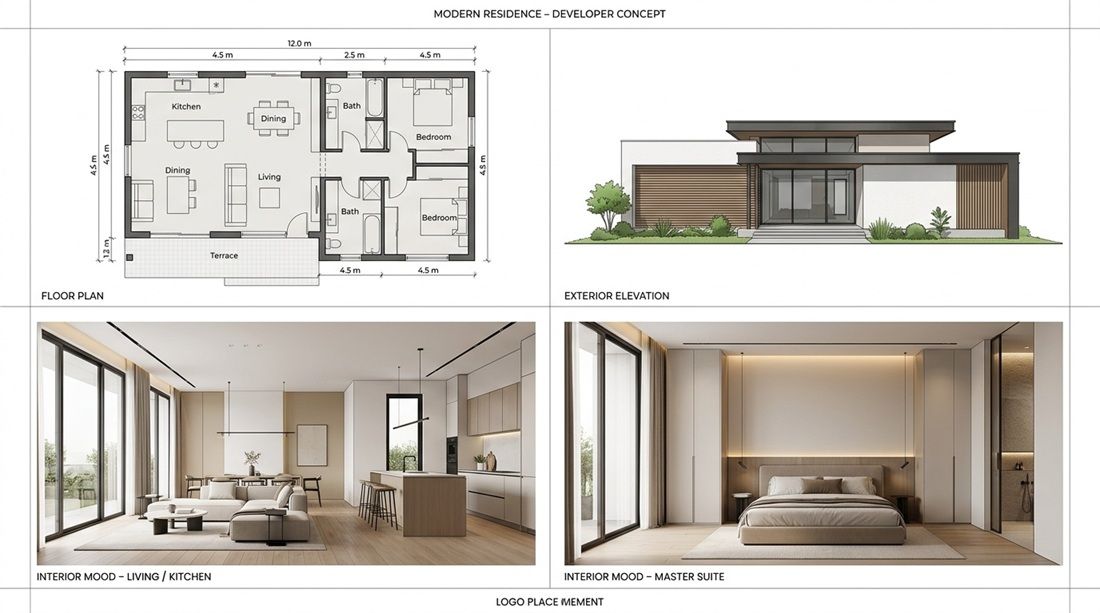
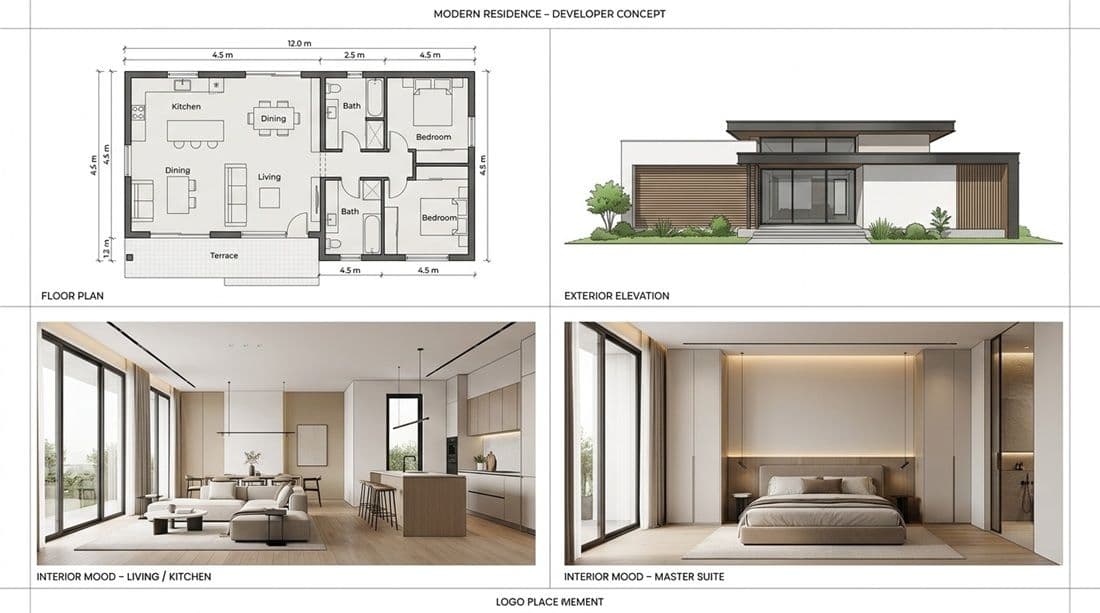
That shift becomes obvious in the multi-view residential concept board above. In a single output, a plain language brief begins to express itself as a floor plan, an exterior concept, and interior mood views. That is not just image generation. It is the compression of several early-stage thinking steps into one workflow.
The easiest mistake in this category is to think the breakthrough is simply “AI can draw floor plans.”
That is not the real story.
A floor plan by itself is only one artifact. What users actually need is a way to move from concept to evaluation. They want to know whether the space feels coherent, whether the layout supports the target buyer or tenant, whether circulation is efficient, whether the design supports the product positioning, and whether the concept deserves deeper work.
This is why generation alone is not enough.
GRAI’s opportunity is much bigger than producing a good-looking plan. The value comes from combining contextual generation with real estate logic. In practice, that means the platform can become useful not only for showing a concept, but also for helping a user think through what that concept implies.
A user might start with a prompt such as:
Create a compact 2BHK apartment for an urban buyer,
Generate a 3BHK around 2,000 square feet for family living,
Design a workplace layout for a growing corporate team,
Or map a full-service restaurant with guest flow, kitchen separation, and private dining.
From there, GRAI can generate contextual outputs that give the user something concrete to inspect.
These are early layout hypotheses that show room relationships, furniture fit, circulation intent, and space zoning.
These outputs begin to define the feel of the space, helping teams think in terms of product positioning rather than only raw layout.
These outputs help express frontage, form, entry treatment, and visual character much earlier than a conventional workflow typically allows.
Once a concept exists, it can be critiqued through a real estate lens. Does the plan align with the likely buyer? Is there wasted circulation? Does the office layout support density? Does the restaurant layout support service flow?
This is where GRAI stops behaving like a novelty generator and starts behaving like a real estate decision tool.
See how this works in real time.
Try generating your own floor plan, layout, or concept using GRAI and move from idea to spatial direction instantly: https://internationalreal.estate/chat
The current examples are already enough to show the category shift clearly.
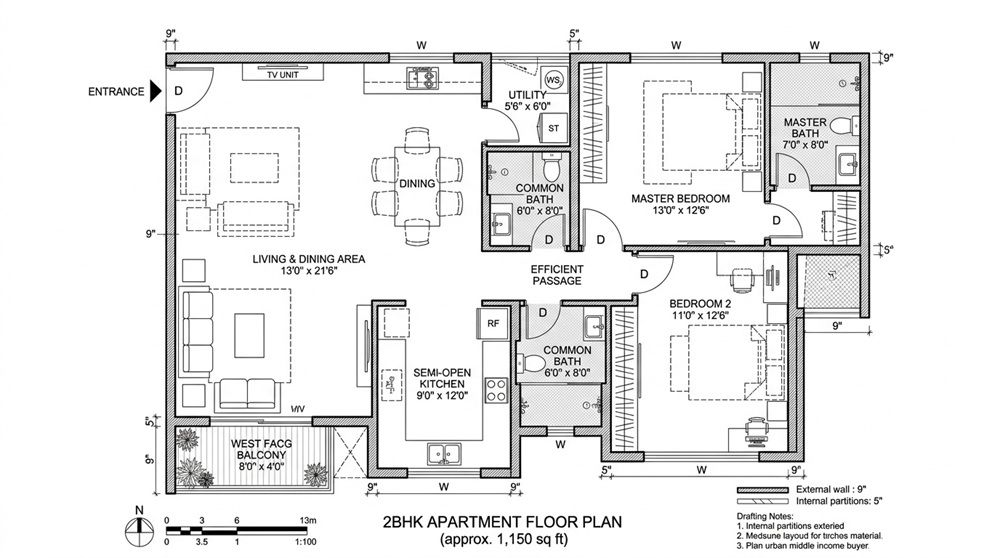
Take the compact 2BHK concept. The output is not just aesthetically clean. It shows a reasonable understanding of room hierarchy, kitchen placement, utility location, bedroom zoning, and furniture scale. For a user trying to think through urban apartment efficiency, this is a far better starting point than a blank page.
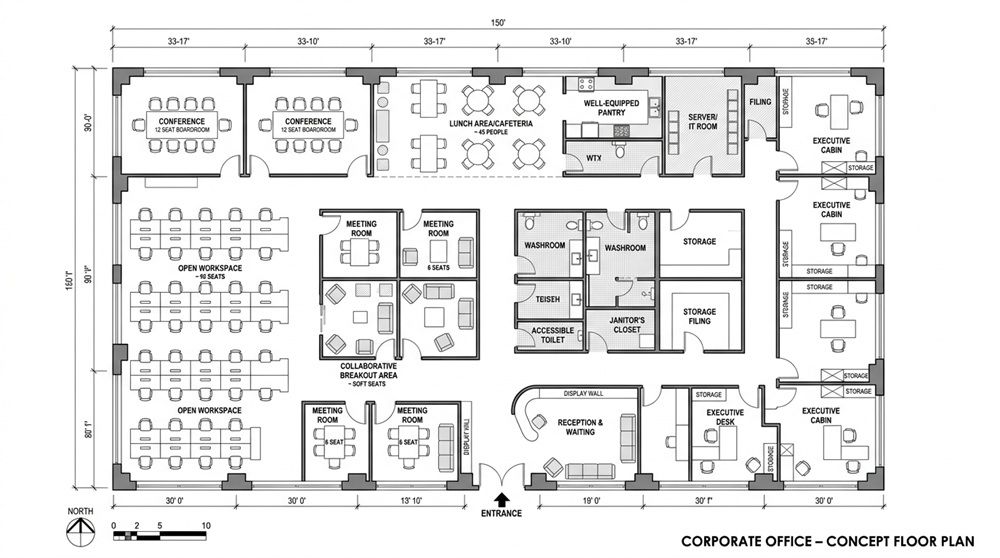
The office example shows something different. It understands organizational logic. Reception, open workspace, meeting rooms, washrooms, pantry, storage, and executive cabins are placed in a way that reflects real workplace planning intent. Even where dimensional integrity still needs human checking, the platform is already producing a context-aware operational concept, not just a decorative diagram
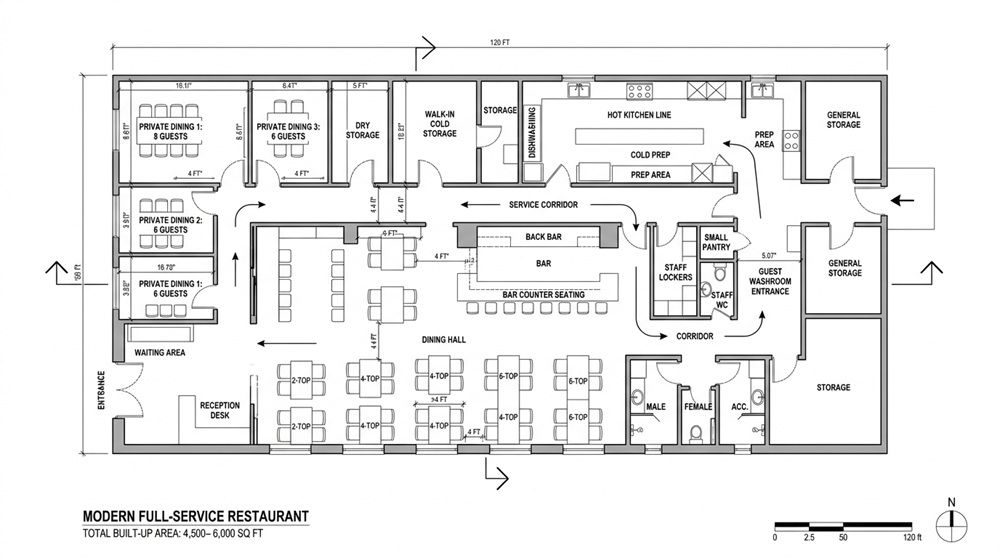
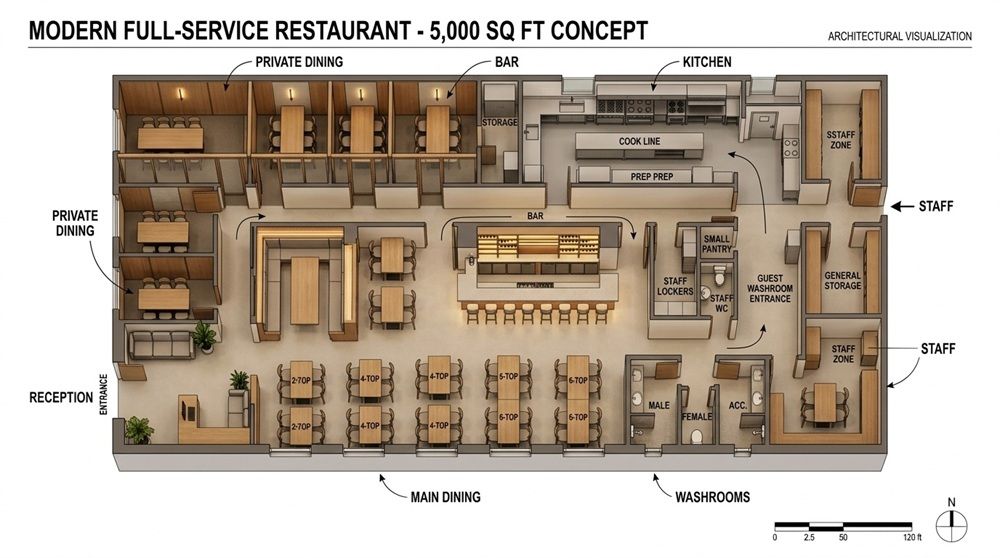
The restaurant example extends that further. Guest-facing seating, private dining, back-of-house, prep, bar flow, service corridor logic, and washroom placement are all interpreted through the lens of hospitality use. Again, this is where the capability becomes commercially interesting. The system is not only generating form, it is inferring function.
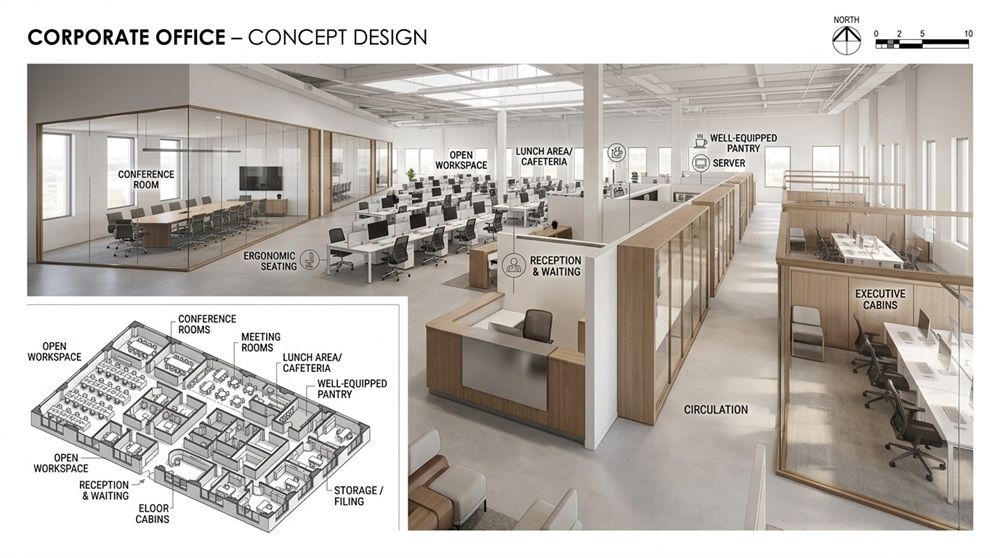
And the presentation-style office concept reveals another layer of value. Users are not restricted to a technical-looking plan. They can move quickly into stakeholder-friendly visualization. For internal teams, clients, or investors, that can reduce the friction between idea and alignment dramatically.
This distinction needs to be stated clearly.
These outputs should not be positioned as architect-grade, permit-ready, code-cleared, or technically verified drawings. In the examples we reviewed, some plans were spatially convincing but still showed inconsistencies in dimensions, notation, labels, or area reconciliation.
That does not weaken the product story. It sharpens it.
The right message is this:
GRAI can generate strong, context-aware schematic concepts that help users explore options, compare layouts, and accelerate early-stage real estate thinking. Human experts still validate and refine before technical reliance.
This is where the commercial case becomes even more interesting.
Traditionally, turning a real estate idea into a usable visual artifact has real friction attached to it. It takes time. It often takes specialist tools. It usually takes multiple iterations. In many cases, it also requires paid design effort before the user even knows whether the direction is worth pursuing.
GRAI changes that equation.
At $4.99, the platform can give a user access to context-aware visual exploration that would otherwise require substantially more time, more tooling, more manual effort, or an early handoff into a professional workflow. That does not replace architects, planners, or serious design software. It does something earlier and often more valuable at the front end: it lowers the cost of getting to a meaningful first visual hypothesis.
That is a major difference.
The comparison should not be “GRAI versus CAD.” The better comparison is “GRAI versus the cost of waiting, guessing, and iterating blindly before a concept even exists.”
For developers, investors, and operators, that lower-cost starting point can be extremely powerful. It means more options can be explored. More ideas can be screened. More layouts can be challenged. And weak directions can be discarded before heavier time and money are committed.
That is not just cheaper visualization. It is more efficient real estate thinking.
The old workflow often looks like this:
Brief
Discussion
Assumptions
First concept
Review
Revision
Feasibility questions
More revision
The new workflow can look more like this:
Prompt
Concept
Critique
Revision
Investment discussion
Next concept
That compression is significant because it shortens the gap between intent and reaction. Once a user can see something, they can improve it. Once they can compare options, they can make sharper choices. Once the visual concept exists, underwriting and feasibility conversations become more grounded.
This is especially useful in four scenarios:
Developers can explore product direction earlier, compare variants, and align stakeholders before deeper design work begins.
Investors can test whether a concept feels spatially plausible and commercially aligned before sinking time into extensive analysis.
Office, hospitality, and mixed-use operators can examine workflow logic, staff movement, and space allocation much faster.
Architects and designers can begin from a sharper first artifact, with the brief already translated into something spatial and discussable.
The strongest signal from the examples is not that a plan can be made. It is that a single prompt can be translated across multiple layers of representation.
As shown in the residential concept board at the start of the article, the same starting brief can produce:
A plan,
An exterior concept,
A living and kitchen mood view,
And a master suite mood view.
That has major implications for developers and product teams. It means the asset can start being understood as a product, not just as a layout. Teams can think about use, identity, feel, buyer fit, and positioning much earlier in the process.
This is where GRAI begins to feel like a real estate intelligence platform with generative capabilities, not just a visual tool with prompts.
Faster concept iteration, earlier alignment, better starting points for design conversations.
Quicker screening of asset ideas, clearer visual grounding for feasibility discussions, and faster rejection of weak concepts.
More efficient space planning for offices, restaurants, hospitality, and other operating assets where flow and allocation shape outcomes.
A better front-end artifact to react to, critique, and refine.
A clearer view of where vertical AI is headed. The strongest platforms will combine intelligence, generation, evaluation, and workflow compression.
AI can accelerate the beginning of the process. It should still be used carefully and not rush to finish the process on its own.
Human expertise is still essential for:
Technical validation,
Dimension verification,
Code compliance,
Structural review,
MEP planning,
Detailed design development,
Construction documentation,
And execution.
That is the right division of labor.
GRAI improves the front end. Human experts secure the back end.
Real estate has always suffered from friction between thinking and making. Strategy sits in one place. Design begins somewhere else. Feasibility gets layered in later. Visual communication often arrives after too much time has already passed.
GRAI points toward a different model, one where the movement from prompt to plan to critique to investment discussion becomes much shorter, much cheaper, and much more iterative.
That is where this category is heading.
The winning platforms will not be the ones that produce the prettiest isolated outputs. They will be the ones that connect intelligence, underwriting, spatial generation, and decision support in a single loop.
That is the direction GRAI is building toward.
AI-generated floor plans are not the destination. They are the new entry point.
What GRAI unlocks is not just visual output. It is a lower-cost, faster, more context-aware way to begin real estate thinking. A user can start with intent and reach something visible, discussable, and improvable in minutes.
That changes the economics of exploration. It changes how quickly teams can align. And it changes how early better real estate decisions can begin.
Want to see what this looks like in practice?
Use GRAI to generate contextual real estate concepts, pressure-test layouts, explore product direction, and move from prompt to visual hypothesis in minutes.
At $4.99, it is one of the lowest-friction ways to start turning real estate intent into actionable spatial direction.
Try GRAI and see how quickly your next concept can take shape
GRAI is a real estate AI platform designed to support faster decision-making through contextual intelligence, underwriting-oriented thinking, and increasingly, spatial and visual concept generation.
Yes. GRAI can generate floor plan-style concept outputs from plain language prompts. These are useful for early exploration, comparison, and stakeholder discussion.
They can be visually convincing and spatially plausible, but they still require human validation. Users should not assume the dimensions, labels, or technical details are final without professional review.
Yes. GRAI is not limited to floor plans. It can also support interior mood direction, exterior concept generation, and multi-view presentation outputs.
GRAI reduces the cost of contextual visualization by allowing users to generate and iterate on real estate concepts quickly, without immediately moving into heavier professional workflows or specialist tool chains.
No. GRAI is currently positioned as an early-stage concept and decision acceleration tool. Architects, planners, and technical design software remain essential for validation, compliance, and delivery.
Developers, investors, operators, design teams, proptech buyers, and venture investors can all benefit from faster concept generation and more grounded early-stage review.
Residential apartments, villas, offices, restaurants, hospitality layouts, and other real estate concepts can all benefit from this workflow.
Investors can explore the spatial plausibility and product direction of an idea much earlier, making feasibility discussions more concrete.
Because it points to a more advanced category of vertical AI, one that combines intelligence, generation, and decision support instead of offering disconnected tools.


