Ask GRAI Anything
Your Real Estate Questions, Answered Instantly via Chat

Help us make GRAI even better by sharing your feature requests.
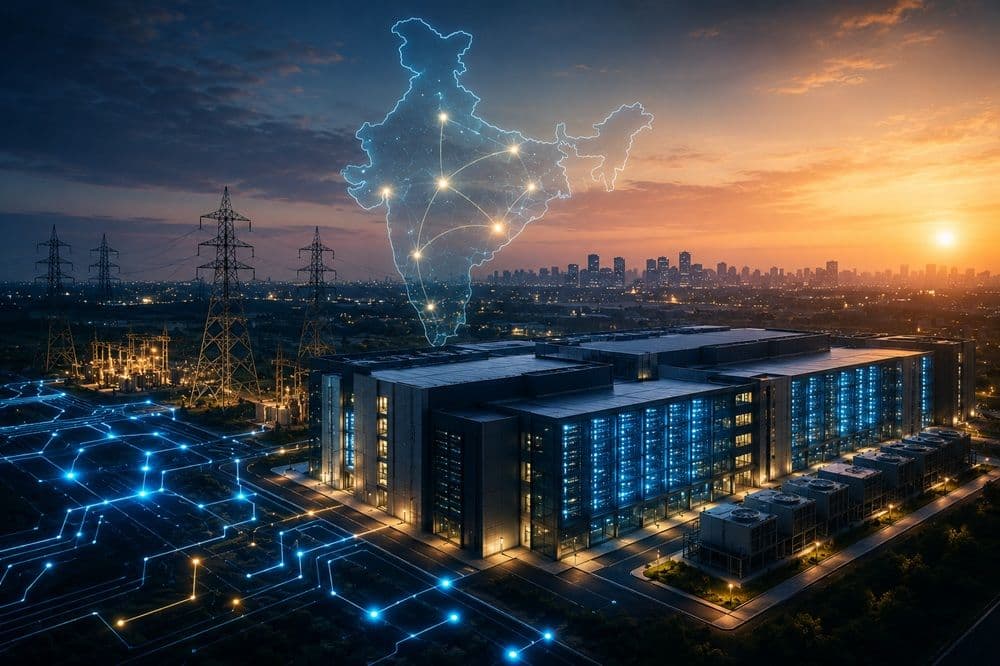
India data centers are no longer a niche digital infrastructure story. They are becoming one of the most important institutional CRE and infrastructure themes in the country. Microsoft said in May 2026 that its largest India data center campus in Hyderabad is on track to go live by mid 2026 as part of its broader $17.5 billion investment push, a major signal of hyperscaler conviction.
At the same time, India’s peak power demand hit a record 270.73 GW in May 2026 during a severe heatwave, exposing how central grid stress and power access are becoming to the data center buildout story. Reuters also reported in April that the global AI boom is creating a new premium around “powered land,” because land without credible power access is increasingly less valuable than land with real grid readiness. That is why the right way to analyze India data centers now is not simply “AI demand is rising.” It is “which sites have power, land control, and execution timing before everyone else arrives.”
Many people still discuss data centers as if they are mostly about servers, cloud adoption, and software demand. That misses the real estate and infrastructure layer that is now becoming more important. Once hyperscalers and enterprise operators expand aggressively, the physical bottlenecks move to land assembly, power availability, substation access, cooling strategy, permitting, and delivery speed. Reuters’ reporting on “powered land” makes the point clearly: in the AI era, generic industrial land is not the same as land that can actually support massive power loads on a realistic timetable. For institutional CRE investors, that changes the opportunity set. The value may increasingly sit not just in the shell, but in the site and utility advantage underneath it.
The demand side is not the weak link here. Microsoft’s May 2026 comments are among the strongest signals yet that India has moved from future promise to active hyperscaler deployment. The company said its biggest India data center campus, in Hyderabad, is expected to go live by mid 2026 and framed India as a critical market for AI and cloud expansion. This matters because hyperscaler commitments tend to validate an entire ecosystem, from landowners and utilities to contractors and adjacent logistics and connectivity providers. It means the market is not waiting for demand to show up. Demand is already shaping real asset decisions.
The harder part of the story is not digital demand. It is electricity.
Reuters reported that India’s power demand touched a record 270.73 GW on May 21, 2026, as extreme heat drove cooling consumption sharply higher and some regions faced outages. In a country where peak load is already stressing the system, data center expansion becomes a site selection and infrastructure alignment problem as much as a technology problem. Data centers are not ordinary industrial users. They need reliable, scalable, continuous power. That means a site with cheap land but weak power certainty may be far less valuable than a more expensive site with credible grid access and delivery timelines. This is the point at which a real estate AI platform becomes useful, because the best asset is no longer the most obvious one. It is the one with the strongest infrastructure logic.
Hyderabad is emerging as one of India’s most important data center nodes precisely because it appears to combine tech ecosystem depth with major hyperscaler commitment. Microsoft’s decision to anchor its largest India campus there is not just an isolated corporate move. It signals that the city is being treated as a serious long term infrastructure base for cloud and AI workloads. When one of the world’s largest technology companies makes that scale of bet, the surrounding real estate implications widen. Land close to viable power, strong fiber connectivity, and stable development conditions becomes more strategically valuable. That is why data center real estate is no longer just about the building. It is about the ecosystem around the building.
Maharashtra is important for a different reason: scale. Reuters reported in January 2026 that Macrotech Developers, also known as Lodha Developers, planned to invest an additional 1 trillion rupees, about $11 billion, in a 2.5 GW data center park in the state. That is a massive real estate and infrastructure commitment. The significance is not just the number. It is what the number implies. At this scale, the project is not a side business or a speculative annex to industrial real estate. It is a major new form of infrastructure led land use, where power, policy support, financing, and site control all become central. For institutional CRE, that is exactly the kind of theme that can reprice whole corridors if executed well.
Use GRAI to compare India’s emerging data center corridors on power, policy support, and land economics before you commit capital: https://internationalreal.estate/chat
One of the most useful framing devices for this story comes from outside India. Reuters reported in April 2026 that the AI boom is distorting real estate values globally by creating scarcity around powered land. The article described how developers were racing to secure sites with credible access to electricity, while other locations without power readiness risked turning into “zombie” projects. That concept applies very strongly to India. As AI and cloud demand accelerate, not every site marketed as “data center land” will become a viable asset. Some will simply be industrial plots with insufficient utility logic. The winners will be the assets where power, permitting, timing, and location line up together.
A common mistake is to assume the entire opportunity sits with the operating company. That is too narrow. The value can sit across several layers:
Landowners controlling credible powered sites
Developers with entitlement and infrastructure coordination capability
Utilities and energy partners aligned to large load growth
Adjacent industrial and logistics real estate near new digital corridors
Long duration capital backing infrastructure scale buildouts
That is why India data centers are such an interesting institutional CRE topic. The most valuable position may not always be owning the final rack filled building. It may be controlling the asset or relationship that makes that building possible in the first place.
Every hot CRE theme eventually attracts too much easy capital. That is when the market starts rewarding the wrong story. Investors begin paying up for anything labeled AI, cloud, or digital infrastructure, even if the underlying site has weak power logic or questionable execution pathways. Reuters’ “powered land” reporting is effectively a warning against this. Not every site near a tech corridor is useful. Not every industrial parcel can become a serious data center asset. And not every announced project will translate into scalable infrastructure. The real bottleneck is not enthusiasm. It is credible delivery.
For a serious institutional investor, the right questions are much sharper than “is data center demand strong.” They are:
How much secured power can the site realistically obtain
What is the grid upgrade timeline
How resilient is supply during peak stress conditions
What are the cooling and water implications
How competitive is the site on fiber and latency
How hard is land assembly and entitlement
What happens if everyone chases the same corridor at once
These are not side questions. They are the difference between real data center real estate and marketing collateral. In a constrained infrastructure environment, the underwriting edge belongs to the investor who understands utility risk and timing better than the investor who only understands demand.
India is attractive because it combines very large digital demand with a still developing infrastructure base. That creates both opportunity and bottleneck. In mature markets, hyperscaler demand may already be heavily priced into the land. In India, parts of the value chain may still be less fully repriced, especially where land, utility coordination, and policy support are only starting to converge. That is often where outsized institutional CRE opportunity sits, not in the most obvious story, but in the early bottleneck before the market fully understands it.
This is exactly the kind of opportunity where the GRAI real estate AI platform should help investors think more clearly. A normal market note can tell you that AI demand is rising and hyperscalers are expanding.
A real estate AI platform should help answer more difficult questions:
Which Indian nodes have the strongest combination of power, policy, and land?
Which sites are genuinely “powered land” and which are just industrial plots with a story?
How should Hyderabad compare with Maharashtra, Chennai, or other emerging corridors?
What is the downside if power bottlenecks worsen or land costs reprice too quickly?
Where does value sit, in the operator, the campus shell, the site, or the grid aligned landbank?
Useful prompts:
“Compare Hyderabad, Maharashtra, and other Indian data center nodes on power availability, land advantage, and long term institutional CRE potential.”
“Tell me whether this site has real powered land potential or is just generic industrial land wearing an AI narrative.”
“Stress test an India data center real estate thesis for power bottlenecks, grid delays, and land cost inflation.”
“Explain where the value sits in India’s data center boom, the operator, the shell, the land, or the power access.”
Ask GRAI to stress test any India data center site for power bottlenecks, grid delays, and true powered land potential: https://internationalreal.estate/chat
Because hyperscaler demand is now real and large, while the key bottlenecks have shifted to land, power, and delivery. That makes data centers as much an infrastructure real estate story as a technology story.
Powered land is land that has credible access to the large scale electricity needed for data center development. Reuters reported in April 2026 that the AI boom is creating a premium around such sites globally because generic land without power is much less useful for serious digital infrastructure.
Because demand alone does not create a functioning data center asset. India’s record peak power demand in May 2026 shows how stressed the system can become, and data centers need reliable high load electricity to operate.
Microsoft said its largest India data center campus is being built there and is expected to go live by mid 2026, making Hyderabad one of the country’s most important digital infrastructure hubs.
Because of scale. Reuters reported Macrotech Developers planned a 2.5 GW data center park there with an additional 1 trillion rupee investment, showing how large the state’s role could become.
Potentially both, but the underappreciated opportunity may be in land and utility aligned site control, because those are the assets that become hardest to replicate when demand accelerates.
Overpaying for the narrative. Not every industrial plot marketed as AI or data center land will become a viable powered site. Delivery and utility reality matter more than branding.
They need to test power access, grid timelines, entitlement, cooling requirements, fiber connectivity, and development feasibility rather than relying on market hype.
Yes. A real estate AI platform like GRAI can compare cities, sites, power constraints, and risk scenarios more systematically than static commentary.
India’s next major institutional CRE trade may not be office towers or luxury housing. It may be the race to control the right powered land before everyone else realizes that the scarcest asset in the AI era is not generic industrial real estate.
It is infrastructure ready real estate.
That is why the best way to read India data centers in 2026 is not “AI demand is rising.” It is “power, land, and timing are becoming the real bottlenecks.” And once a market starts repricing bottlenecks instead of stories, the smartest investors are usually the ones who got there first.


