Ask GRAI Anything
Your Real Estate Questions, Answered Instantly via Chat

Help us make GRAI even better by sharing your feature requests.
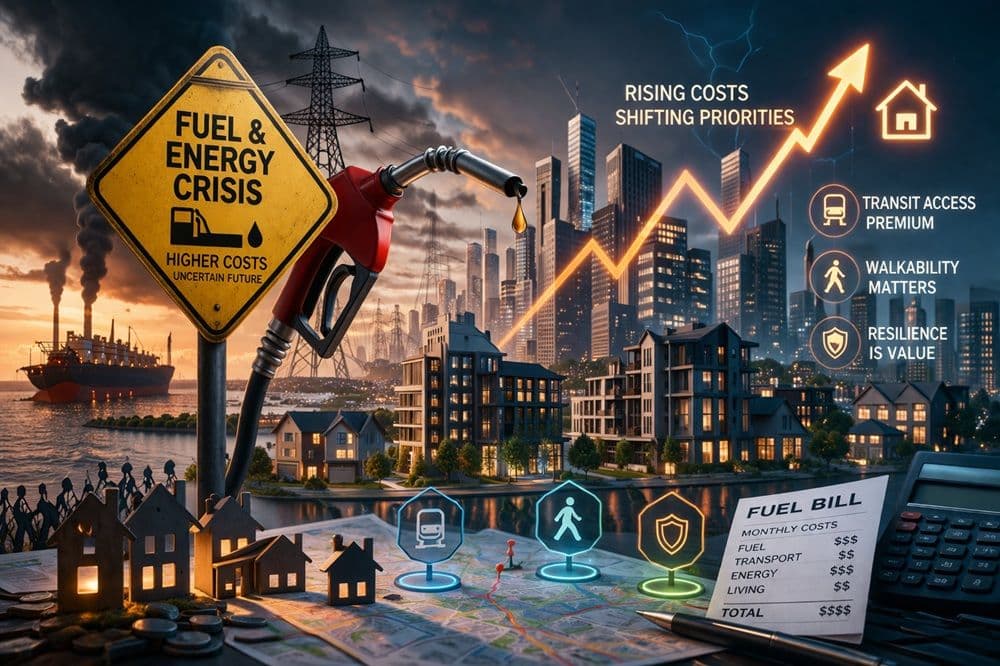
The latest energy shock is not just a fuel story. It is a housing story. In Australia, Prime Minister Anthony Albanese addressed the nation on April 1, 2026, warned that the economic effects of the Iran war could last for months, urged people not to hoard petrol, and encouraged lower fuel use through public transport and walking, while the government halved fuel excise for three months and suspended the heavy vehicle road user charge.
In Europe, EU Energy Commissioner Dan Jorgensen said the bloc should prepare for prolonged disruption to energy markets, revived discussion of crisis style demand reduction tools, and warned that war damaged energy infrastructure would keep pressure on prices even if fighting stopped immediately. When leaders begin openly discussing fuel saving and lifestyle adjustment, the definition of a good property location starts to change. Homes that reduce commuting dependence and improve daily resilience can gain relative value, while car dependent locations face new pressure.
Real estate markets often react slowly to macro shocks, but they react faster to changes in daily living costs. Fuel is one of those costs. If governments are publicly urging people to walk more, use transit more, delay discretionary driving, or prepare for prolonged disruption, then housing demand can start shifting before price indices fully reflect it.
This is important because location premiums are often built on old assumptions. Cheap fuel and frictionless commuting made some outer suburban and fringe property trades look stronger than they really were. A fuel shock does not automatically crash those areas, but it can expose how much of their value depends on driving remaining easy and affordable.
A home is not just walls and land. It is also a mobility system.
If fuel costs rise, shortages emerge, or governments push lifestyle changes to reduce transport demand, then households begin reassessing:
How far they live from work
How dependent they are on one car or two cars
Whether the neighborhood works without constant driving
How expensive the commute becomes in a high fuel environment
That means “good location” starts changing. Proximity, walkability and 15-minute city style planning, and public transport access can become more valuable, not as urbanist slogans, but as hard cost of living protection.
Also Read: Global Property Risk After the Iran-U.S. War Oil Shock
Australia matters because the government is not speaking in abstract energy market language. It is speaking in direct household behavior language.
Reuters reported that Anthony Albanese said the government would halve the excise on fuel and diesel for three months, remove the heavy road user charge, and adopt a national fuel security plan to deliver fuel to regional areas where it was most needed. Reuters also reported that Australia had enough for only around 30 days of diesel and jet fuel and 39 days of petrol according to the latest government figures, still far below International Energy Agency guidance. It further noted that average retail diesel had risen above A$3 a litre and petrol to A$2.50 a litre by late March.
Those details matter because they turn transport resilience into a real estate variable.
Europe matters because its message is broader than one country. Reuters reported that EU energy ministers were discussing measures that resemble parts of the 2022 energy crisis toolkit. Dan Jorgensen said Europe should prepare for prolonged disruption to energy markets and that even a peace agreement would not quickly normalize conditions because energy infrastructure had already been damaged. Reuters also reported that the EU was concerned about refined fuel products, especially jet fuel and diesel, and that European gas prices had risen more than 70% since the war began. The emergency response discussion included ideas such as curbing grid tariffs and electricity taxes, while the wider 2022 style toolkit included demand reduction targets.
Once leaders begin talking about demand reduction and prolonged disruption, real estate investors should understand that housing demand patterns may start shifting.
The pattern is already visible outside Australia and Europe too. Reuters’ March 31 global energy and commuting report said countries were responding to the oil shock with fuel tax cuts, driving curbs, remote work policies, and guidance to reduce transport use. The report cited South Korea considering driving curbs, the Philippines declaring a national energy emergency, Sri Lanka cutting the work week, and Ethiopia shifting toward virtual meetings to reduce fuel use. That is important because it shows the housing implication is not local - it reflects global capital flows reshaping real estate markets. When work, travel, and commuting habits are being actively reshaped by governments and employers, real estate location value starts shifting too.
In a fuel stressed environment, the strongest housing is often not simply the biggest or most aspirational. It is the housing that still works well when driving becomes expensive or uncertain.
That usually favors:
Neighborhoods with rail, tram, or metro access
Inner and middle ring suburbs with mixed use convenience
Places where schools, retail, and services are reachable without long drives
Apartments and townhouses in genuinely connected districts
Homes close to employment clusters
The point is not that density always wins. The point is that mobility resilience starts carrying more value.
Analyze Fuel Shock Risk with GRAI: https://internationalreal.estate/chat
Car dependent property does not instantly become bad property. But its trade off changes.
The traditional bargain in many markets has been:more space, lower entry price, longer drive.
That bargain weakens when:
Petrol becomes much more expensive
Fuel access looks less reliable
Governments openly encourage reduced driving
Households start treating commute cost as part of housing affordability
That creates pressure on:
Fringe suburban housing
Long commute lifestyle stock
Outer growth corridors with weak public transport
Areas where daily life requires several car trips
Again, this is not necessarily a crash thesis. It is a location premium reset thesis.
For Australian households, the most immediate effect is on affordability logic.
A home that looks cheaper on headline mortgage cost may no longer be cheaper once you add:
Higher petrol bills
More time commuting
Greater dependence on one or two cars
Higher exposure to supply disruptions
Less flexibility if transport habits need to change quickly
That can lead households to:
Stay renters longer in better connected areas
Pay more for transport efficient locations
Downsize land ambition in exchange for lower running costs
Place a higher premium on daily convenience
In other words, the fuel shock can reprice housing without any change in mortgage rates at all.
Foreign buyers often screen Australia through the lens of legal clarity, rule of law, education, quality of life, and city brand strength. Those advantages remain real. But this moment highlights something else: a safe country is not the same thing as an energy independent country.
Australia imports about 90% of its fuel, according to the prime minister’s address and subsequent reporting, which means imported energy risk is now part of the housing equation. For global capital, this does not mean “avoid Australia.” It means be more selective about submarkets. In a fuel stressed world, properties with strong public transport access, walkability, and lower commuting dependence become more defensible than purely car dependent lifestyle trades.
Just like in other macro shocks, rents often move faster than sale prices in functional submarkets.
If households respond to fuel stress by relocating toward transport efficient neighborhoods, rental demand can strengthen quickly in:
Inner city apartments
Middle ring family neighborhoods with train access
Mixed use districts
Areas close to jobs and schools
Meanwhile, sale prices may take longer to reflect the shift because buyers and sellers adjust more slowly. This means rental demand near transit can become one of the earliest signs that the location premium is changing. This reflects broader rent vs buy dynamics in shifting housing markets.
Fuel stress does more than change commuting.
It can also affect:
Construction costs through diesel and transport inputs
Maintenance costs because tradies and service providers travel more expensively
Logistics costs, which feed into local retail and daily living
Household budgets, which changes what buyers can really afford
Employer flexibility, which may reinforce remote or hybrid work in some sectors
That means the property effect is broader than “people may drive less.” It can alter total cost of ownership and the practical usefulness of specific locations.
The interesting thing is not only what Albanese said, or what EU leaders and the energy commissioner are saying. It is that both messages point toward the same housing implication.
The question of a good home is becoming more connected to:
How transport resilient the household is
How much daily life depends on fuel
Whether the property works under stressed mobility conditions
Whether the neighborhood can function with less driving
That is a much more global insight than a single country policy reaction. It suggests a broader reset in how housing markets value convenience, density, infrastructure, and self sufficiency.
If you are evaluating any property in Australia or Europe right now, ask:
How many weekly essential trips depend on driving
What realistic public transport alternatives exist
How much of the household budget would fuel consume in a prolonged shock
Would the area still feel functional if travel became more expensive and less flexible
Does the property benefit from proximity, or only from cheap fuel assumptions
How would rental demand change if more households prioritized mobility resilience
That framework is more useful than simply asking whether a suburb is “good.”
The most important real estate effect of the current fuel shock is not a crash. It is a re-ranking of location quality.
Homes and neighborhoods that reduce transport dependence are becoming more valuable because they protect households against a wider set of risks:
Expensive fuel
Supply disruption
Commuting fatigue
Changing work patterns
And broader cost of living pressure
That makes this more than an Australia story and more than a Europe story. It is a global property insight into how energy stress can quietly redraw what counts as a strong location.
This is exactly the kind of market shift where a real estate AI platform is useful because the issue is not just price. It is the interaction of transport, affordability, household behavior, and local geography.
Useful prompts:
“Compare two Australian (or European) suburbs by fuel shock resilience, including public transport access, walkability, commuting dependence, and likely rental support.”
“Stress test this property if petrol and diesel remain expensive for six months and households prioritize transport efficient locations.”
“Tell me whether this suburb’s value depends more on land size or mobility resilience.”
“Compare inner ring and fringe housing under a prolonged transport cost shock.”
Compare transport resilience, walkability, and long-term location risk using GRAI: https://internationalreal.estate/chat
Fuel prices affect real estate by changing commuting costs, household budgets, neighborhood convenience, and total cost of ownership. In a prolonged fuel shock, properties that reduce car dependence often become more attractive relative to highly car dependent locations.
Because location quality is partly about how easily daily life works. If fuel becomes more expensive or less reliable, walkability, public transport access, and proximity to jobs and services become more valuable.
Not automatically. But they can make outer suburbs less attractive relative to better connected areas if households start placing a higher premium on commuting resilience and lower transport costs.
Reporting on April 1, 2026 said Anthony Albanese warned the economic effects of the Iran war could last for months, urged people not to hoard petrol, encouraged reduced fuel use through public transport and walking, and announced a temporary halving of fuel excise plus other support measures.
EU Energy Commissioner Dan Jorgensen said Europe should prepare for prolonged disruption to energy markets and discussed using crisis style measures similar to those used in 2022, including tools linked to reducing demand and cushioning households from high costs.
It likely increases the relative appeal of Australian submarkets with strong transport access, walkability, and lower dependence on daily driving. The country remains legally attractive, but submarket selection becomes more important when imported fuel risk rises.
Yes. If more households seek transport efficient areas, rental demand can strengthen first in walkable or transit linked neighborhoods, even before broader sale prices fully adjust.
It depends on how long fuel stress lasts. But even temporary shocks can change buyer behavior, and repeated shocks can permanently increase the premium on transport resilient locations.
Yes. A strong AI-driven real estate analysis platform can compare suburbs, stress test properties under different fuel cost scenarios, and evaluate whether value depends more on land size or mobility resilience.
When leaders start telling citizens to drive less, walk more, and prepare for prolonged energy disruption, real estate should listen.
The important shift is not political messaging by itself. It is what that messaging reveals about the economy households are now living in.
In that economy, a good location is no longer only about prestige, schools, or beach proximity.
It is increasingly about whether life still works when fuel is expensive, movement is constrained, and convenience becomes a form of resilience.


