Ask GRAI Anything
Your Real Estate Questions, Answered Instantly via Chat

Help us make GRAI even better by sharing your feature requests.
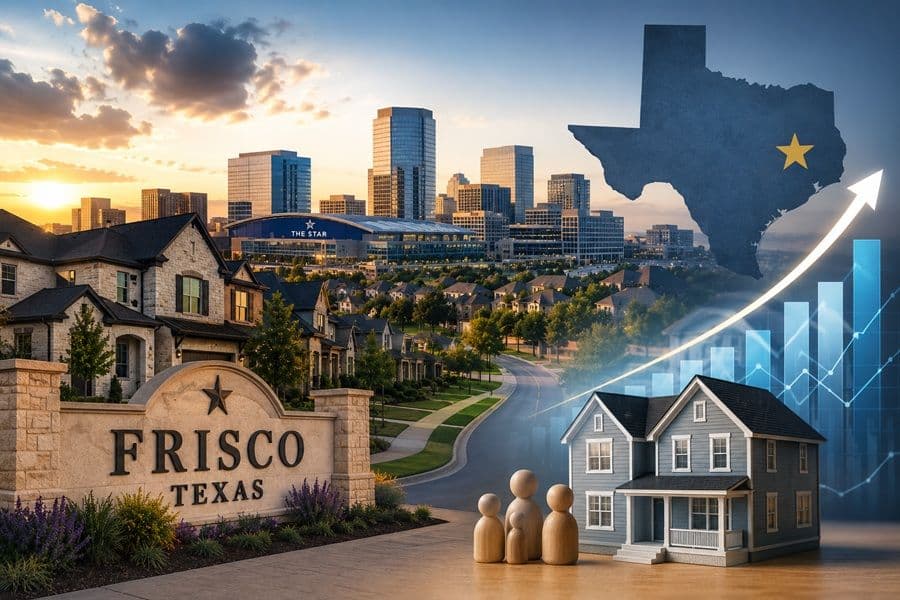
Frisco has become one of those places people argue about online as if one group arrived and broke the housing market.
That is the easy story.
It is also the wrong starting point.
When a suburb becomes more expensive, more crowded, more diverse, and more politically tense than longtime residents remember, people often look for the most visible explanation. Sometimes that explanation is immigrants. Sometimes it is Californians. Sometimes it is investors, apartments, builders, school rankings, corporate relocations, or remote workers. Each may have some connection to demand, but none of them alone explains what has happened to Frisco.
The better way to understand Frisco is as a growth absorption problem.
A growth absorption problem happens when demand arrives faster than a local system can comfortably absorb it. The demand may come from many places: job growth, domestic migration, international migration, high-income households, school-driven family demand, corporate expansion, lifestyle migration, investors, renters, and people moving within the same metro area. The pressure is not created by one category of people. It is created when the city’s housing supply, infrastructure, schools, roads, utilities, services, and political capacity cannot keep pace with the speed and shape of growth.
That is the real Frisco story.
It is not only about who moved in. It is about whether the city could absorb what came with them.
Frisco’s growth has been extraordinary. U.S. Census QuickFacts estimates Frisco’s population at 236,955 in July 2025, up from an April 2020 estimate base of 200,531. That is an 18.2% increase in just over five years. The City of Frisco’s own demographic page gives an even higher current estimate of 247,860 and notes a buildout population estimate of about 330,000.
Those numbers matter because housing markets do not respond only to sentiment. They respond to households, incomes, school demand, land availability, permits, inventory, commuting patterns, and buyer competition. A suburb growing at Frisco’s pace cannot remain socially, physically, or financially unchanged.
Frisco also has a large foreign-born population. Census QuickFacts reports foreign-born residents at 27.3% for 2020 to 2024, while Asian residents represent 28.1% of the population. That is a meaningful part of the city’s demographic shift, and it helps explain why online debates often connect Frisco’s housing pressure to immigration. But the existence of a visible immigrant community does not prove that immigration is the sole driver of housing stress.
Texas itself shows why that argument is too narrow. The state continued to add more residents than any other state in 2025, but its growth slowed. The Texas Tribune reported that Texas added 391,243 residents in 2025, while international migration to the state fell sharply from the previous year. Texas also saw a significant slowdown in net domestic migration compared with the surge years. The Texas Real Estate Research Center has similarly described Texas as moving from a post-pandemic boom back toward a more normal growth pattern, with international migration slowing sharply.
In other words, the real picture is mixed. Texas is still growing. Frisco is still a magnet. Migration remains part of the story. But the housing pressure cannot be reduced to a single group.
Frisco’s housing demand did not appear by accident. The city sits inside the larger Dallas-Fort Worth growth machine, one of the most important population and employment magnets in the United States. North Texas has benefited from corporate relocations, business expansion, job creation, relative affordability compared with coastal metros, and a reputation for family-oriented suburban living.
Frisco adds its own ingredients to that wider regional pull. It has strong schools, newer housing stock, master-planned communities, retail and entertainment development, sports and corporate visibility, and a lifestyle proposition that appeals to upwardly mobile families. For many buyers, especially families with children, Frisco is not just a housing market. It is a life plan.
That is where demand becomes powerful. A buyer is not simply comparing square footage. They are comparing school access, commute, safety perception, peer networks, community identity, and long-term family stability. When many households make the same calculation at the same time, prices move.
The city’s growth also attracts more growth. New residents support new retail. New retail improves lifestyle appeal. Strong schools attract more families. High-income households attract more services. Corporate activity strengthens the employment base. Each layer reinforces the next.
That flywheel can create enormous wealth for existing homeowners, but it also creates affordability stress for buyers who arrive later.
Immigration can influence housing demand. So can domestic migration, household formation, job growth, investor activity, wage growth, school demand, mortgage rates, land constraints, and builder behavior. The problem with blaming immigration alone is not that migration has no effect. The problem is that it turns a systems issue into a target.
If a high-income software engineer moves from India to Frisco and buys a home, that is demand. If a family moves from California and buys the same home, that is demand. If a Dallas household moves north for schools, that is demand. If an investor buys a rental, that is demand. If a local renter becomes a first-time buyer, that is demand too.
The housing market does not care which narrative people prefer. It adds up demand and compares it with available supply.
The correct question is not, “Which group should be blamed?”
The correct question is, “Why is the local market so sensitive to new demand?”
That question leads to better analysis.
Did Frisco build enough entry-level homes?
Did land prices push builders toward larger homes?
Did zoning encourage enough housing variety?
Did infrastructure expand at the same pace as population?
Did school capacity keep up with enrollment patterns?
Did mortgage rates make existing owners less willing to sell?
Did high-income buyers reset price expectations in certain neighborhoods?
Did rental supply expand in the right locations?
Did local politics resist density until affordability had already become stretched?
Those are the questions that real estate investors, city planners, policymakers, and homeowners should be asking.
Housing debates are rarely only about housing. They are also about identity.
A longtime resident may remember Frisco as quieter, smaller, less expensive, and more familiar. Then the grocery stores change. The restaurants change. The school demographics change. Traffic increases. The price of the next house rises. The buyer pool changes. The neighborhood feels less like the place they chose years ago.
That can feel like growth to one person and displacement to another.
The emotional reaction is real, even when the explanation is incomplete. People do not only respond to data. They respond to the feeling that the place they understood is becoming something else.
This is why housing debates become personal so quickly. A discussion about permits or inventory becomes a discussion about culture. A discussion about school capacity becomes a discussion about who belongs. A discussion about home prices becomes a discussion about immigration.
The challenge is to acknowledge the emotion without letting it distort the analysis.
Frisco’s housing pressure is not imaginary. Affordability has become harder. Competition has been intense. Monthly costs are high. Many families feel squeezed. The question is whether the diagnosis points to real solutions or just creates a scapegoat.
A city attracting people is not a failure. In many ways, it is a sign of success. People move toward jobs, schools, safety, opportunity, status, amenities, and future value. Frisco has offered many of those things.
The failure begins when demand is not absorbed well.
Unabsorbed demand shows up in several ways. Home prices rise faster than incomes. Entry-level buyers get pushed out. Renters stay renters for longer. Larger homes dominate because builders chase higher margins. Roads become congested. Schools need expansion. Infrastructure spending follows growth instead of anticipating it. Local politics becomes more polarized. Existing residents feel overwhelmed, while newcomers feel blamed for simply choosing the same place everyone else already valued.
That is why the term “housing crisis” is often too blunt. Frisco may not have the same type of crisis as San Francisco, London, Toronto, or Mumbai. But it does have a version of the same structural issue: demand wants to concentrate in desirable places, while supply and infrastructure respond slowly.
This mismatch is the essence of growth absorption.
Use GRAI to stress test Frisco style growth absorption risks across different suburbs before you commit capital: https://internationalreal.estate/chat
Housing supply is not only about the number of units. It is about the type, price, location, and timing of those units.
A city can issue permits and still fail to create the homes most needed by the next layer of demand. If most new supply is expensive single-family housing, the market may still underserve teachers, nurses, service workers, young families, first-time buyers, and middle-income households. If apartments are built but political resistance remains high, rental supply may become a cultural battle rather than a housing solution. If homes are built farther out, infrastructure and commute pressure may shift rather than disappear.
The supply question should be more precise: what types of homes does Frisco need to remain functional?
That could include more townhomes, smaller-lot homes, apartments near employment and retail nodes, age-friendly housing, rental communities, and more attainable ownership formats. It could also mean better coordination between housing approvals, school planning, traffic engineering, utilities, parks, and public services.
The point is not that every suburb must become dense in the same way. The point is that a fast-growing suburb cannot rely only on yesterday’s housing model and expect tomorrow’s demand to fit neatly inside it.
Frisco’s growth story has always been closely tied to schools. Strong school reputations attract families, and family demand supports housing prices. But when schools become a core driver of demand, they also become a pressure point.
As new households arrive, enrollment patterns shift. Some campuses become crowded. Boundaries become sensitive. New school construction requires land, funding, staffing, and forecasting. Parents who bought into a specific school expectation may become anxious if rapid growth changes the plan.
Infrastructure follows a similar pattern. Roads, intersections, utilities, parks, drainage, police, fire, libraries, and public facilities all need to scale. Fast growth can make a city look successful while also making daily life feel more strained.
This is another reason the immigration framing falls short. Even if every new resident came from another Texas city, Frisco would still face the same absorption challenge. The origin of demand is less important than the city’s ability to accommodate it.
For real estate investors, Frisco is an important case study because it shows the difference between demand and risk-adjusted opportunity.
High demand can support prices and rents, but it can also create risks. If affordability becomes stretched, future appreciation may slow. If local politics turns against density or investors, regulation may change. If infrastructure lags, quality of life can suffer. If high-income demand keeps pushing prices up, yields may compress. If households begin looking to nearby markets such as McKinney, Prosper, Allen, Plano, or farther north, demand may redistribute.
A strong market is not automatically a good entry point. The investor still has to ask: what is already priced in?
Frisco may remain attractive because of jobs, schools, income levels, and long-term regional growth. But the quality of the investment depends on price, rent, carrying cost, buyer pool, resale liquidity, and the city’s ability to keep absorbing growth.
The same logic applies globally. Desirable markets can become poor investments if entry prices already assume endless demand. A great city can still produce weak returns if affordability, policy, and liquidity move against the investor.
Ask GRAI to compare Frisco with McKinney, Prosper, Allen, and Plano on yields, affordability, and exit risk: https://internationalreal.estate/chat
Real estate conversations often begin with stories. Good analysis has to move beyond them.
GRAI, as an AI real estate intelligence platform, can help users evaluate markets like Frisco by separating political narratives from housing fundamentals. Instead of asking whether one group caused a crisis, a better analysis would compare the actual drivers: population growth, foreign-born population share, domestic migration, income levels, inventory, building permits, price growth, rent growth, school capacity, infrastructure, mortgage rates, investor activity, and nearby market alternatives.
That type of AI real estate market analysis helps investors, buyers, sellers, and policymakers understand whether a market is overheated, undersupplied, mispriced, or simply growing faster than the local system can absorb.
For Frisco, the useful questions are practical.
Is the city’s growth healthy or stretched?
Are prices supported by income and job growth? Is housing supply broad enough for future demand?
Are schools and infrastructure keeping up?
Are nearby markets absorbing the next wave of buyers?
Is the investment thesis based on fundamentals or on scarcity?
Those questions produce better decisions than blaming the newest arrivals.
Use these prompts inside GRAI to analyze the Frisco Texas housing market or similar fast-growth suburbs:
“Analyze whether Frisco’s housing pressure is driven more by population growth, migration, job creation, school demand, housing supply, zoning, interest rates, or investor activity.”
“Compare Frisco with Plano, McKinney, Prosper, Allen, and Dallas on affordability, inventory, rental demand, school pressure, infrastructure, and long-term housing risk.”
Separate political narratives from real estate fundamentals in the Frisco housing market using available population, supply, price, rent, income, and migration data.”
“Forecast whether Frisco’s real estate market has room for sustainable growth or whether prices are already reflecting too much future demand.”
When local narratives get loud, let GRAI benchmark Frisco’s fundamentals against any fast-growth market you care about: https://internationalreal.estate/chat
Frisco is not a simple cautionary tale about immigration. It is a case study in what happens when a suburb becomes a magnet.
Magnets attract people. That is their function. The hard part is not stopping people from wanting to live in a successful place. The hard part is deciding what kind of city that place becomes once the demand arrives.
Does it build enough homes for different income levels?
Does it protect school quality while admitting that school demand is part of the housing market?
Does it plan infrastructure before residents feel overwhelmed?
Does it allow enough housing variety without destroying the qualities that made it attractive?
Does it use data to understand growth, or does it let online narratives define the problem?
These are not easy questions. They are not solved by one zoning change, one apartment ban, one immigration argument, or one political slogan.
The most useful framing is still the simplest: Frisco has a growth absorption problem.
A city can be desirable and still become strained. A market can be strong and still become unaffordable. A suburb can attract global talent and still frustrate longtime residents. A housing market can rise because of demand and still become less functional if supply, infrastructure, and policy lag behind.
The housing debate in Frisco should not be reduced to who moved in. It should focus on what failed to keep up.
Immigration is one part of housing demand in Frisco, but it is not the only driver. Frisco’s housing pressure reflects a wider mix of population growth, domestic migration, international migration, job creation, school demand, high-income households, housing supply constraints, interest rates, infrastructure pressure, and regional growth across North Texas.
Frisco has attracted families, professionals, and investors because of strong schools, corporate growth in North Texas, newer housing, retail and entertainment development, master-planned communities, and quality-of-life appeal. Its growth is also connected to the broader Dallas-Fort Worth expansion.
A growth absorption problem happens when a city attracts more demand than its housing, roads, schools, utilities, services, and political system can comfortably absorb. The result can be rising prices, traffic, school pressure, affordability stress, infrastructure strain, and local conflict.
Frisco may remain attractive because of income levels, school demand, regional job growth, and long-term desirability. However, investors and buyers should evaluate price, affordability, inventory, rental yield, infrastructure pressure, school capacity, and nearby alternatives before assuming continued growth will automatically translate into strong returns.
Buyers should compare Frisco with nearby markets such as Plano, McKinney, Prosper, Allen, and Dallas. They should look at affordability, commute, schools, property taxes, inventory, price trends, resale liquidity, and whether the premium for Frisco is justified by their household needs.
AI can help compare population growth, migration, housing supply, prices, rents, income, infrastructure, school pressure, zoning, and local market alternatives. GRAI helps users structure AI real estate market analysis so they can separate narratives from fundamentals.
GRAI is an AI real estate intelligence platform that helps users analyze property markets, investment opportunities, valuation logic, local risk, market trends, and decision scenarios using available data and structured real estate intelligence.


