Ask GRAI Anything
Your Real Estate Questions, Answered Instantly via Chat

Help us make GRAI even better by sharing your feature requests.

TL;DR: Leaving the US does not end your property obligations. Before moving to India, compare selling with renting using the real after-tax numbers, understand the Section 121 and FIRPTA clocks, and make sure the home can actually be managed from abroad.
You can leave the United States in a day. The house stays behind, but the debt and legal obligations can follow you for years.
That mismatch becomes especially uncomfortable for an H-1B household dealing with a sudden job loss or an unexpected return to India. Immigration circumstances can change in weeks. A mortgage may have another 20 years to run, and a house worth several hundred thousand dollars cannot always be sold, rented or reorganized on the same timetable.
The temptation is to turn the property decision into something simple: sell before leaving, rent it out, leave it empty for a while, or in the most difficult situations, stop dealing with it altogether.
None of those choices can be evaluated from the mortgage payment alone.
A low-rate US mortgage can be a valuable asset. A former home can become a good rental. Selling can release hundreds of thousands of dollars at exactly the point when a family needs liquidity in India. But keeping the property can also introduce US nonresident tax rules, FIRPTA withholding, depreciation, Indian foreign-asset reporting, remote-management risk and a tax clock that homeowners often discover only after it has started running.
The right comparison is therefore not “sell or rent?” It is what each choice leaves you with after five years, after the costs and taxes that actually apply to you.
The mortgage does not end when the borrower leaves the country. Property taxes, HOA assessments, insurance and maintenance continue as long as the person remains the owner.
If payments eventually stop and foreclosure follows, the consequences can remain visible for years. The CFPB says foreclosure generally remains on a US credit report for seven years, which can affect someone's ability to borrow again if they later rebuild a financial life in America.
Moving abroad also does not place US assets beyond the reach of the US legal system. If a creditor sues and obtains a judgment, the available collection tools can include bank-account garnishment and liens, subject to federal and state protections. Someone living in India but leaving ordinary bank or brokerage assets in the US should not assume that those assets are insulated merely because the owner is overseas.
Trying to enforce a judgment against assets in India is a separate question. India's Code of Civil Procedure provides a direct execution mechanism under Section 44A for decrees from notified reciprocating territories, while recognition of foreign judgments is also subject to the Code's wider rules. The practical route for any particular US judgment should be checked with Indian counsel rather than assumed.
The important point is narrower: leaving the United States can make collection more complicated, but it does not erase a valid debt.
Very much so. The consequences after foreclosure are not uniform across the US.
California's purchase-money anti-deficiency protection, for example, can protect qualifying mortgages used to purchase an owner-occupied one-to-four-family dwelling. California law also extends protection through qualifying refinances of the purchase-money balance, while excluding new principal advanced beyond specified amounts.
Washington takes a different approach. Its Deed of Trust Act generally prohibits deficiency judgments after a nonjudicial trustee's sale, except for statutory circumstances involving certain commercial loans.
Texas permits deficiency claims after foreclosure, but the borrower can seek a fair-market-value determination. If the court finds the property's fair market value exceeded the foreclosure-sale price, that difference can reduce the deficiency.
New Jersey also has a statutory deficiency framework following mortgage foreclosure, including procedures allowing the amount of the claimed deficiency to be contested.
So a homeowner in Plano should not assume that a friend in California who “gave the house back” faced the same residual liability. The mortgage documents, foreclosure method and state law all matter.
A normal mortgage default or foreclosure is not listed by the State Department as an automatic ground of visa ineligibility.
US immigration law separately deals with matters such as criminal conduct, drug violations, fraud or material misrepresentation and unlawful presence. Those can create immigration consequences, including the three- and ten-year unlawful-presence bars. Ordinary civil mortgage debt is not listed as a standalone equivalent.
That does not make foreclosure inconsequential. Someone returning to the US later may still have damaged credit, unresolved judgments or US assets exposed to collection.
The distinction is worth keeping clear: a foreclosure can follow someone's future financial life in America without automatically becoming a visa ban.
Even a homeowner who never misses a mortgage payment can create a different set of problems by leaving the property unmanaged.
Under the assumptions used later in this article, simply carrying the empty property costs about $2,570 a month from the mortgage, property tax, existing insurance and HOA alone. That excludes utilities, repairs, lawn or winter maintenance, security, and any additional insurance cost associated with vacancy.
Six months of “we'll decide later” can therefore consume more than $15,000 before those additional expenses.
An empty house also creates a physical-control problem. Water leaks, storm damage, accumulated mail or an unnoticed HOA violation are inconvenient when the owner lives ten minutes away. They are much harder to handle from India.
Unauthorized occupancy adds another layer. There is no nationwide rule under which somebody automatically becomes the owner because they have occupied a home for 30 days. But possession disputes can still require formal legal action.
California illustrates that distinction. People who are not named on a lease can still become involved in an eviction case, while San Francisco generally requires landlords dealing with tenants to use formal notice, unlawful-detainer proceedings, a judgment and sheriff enforcement rather than self-help such as changing locks or disconnecting utilities.
Texas moved in the opposite procedural direction with SB 38. The legislation changed eviction procedures beginning January 1, 2026, including cases involving people who are not entitled to enter, occupy or remain in a property.
Illegal activity or serious property damage can make the situation still more expensive. California courts, for example, identify serious nuisance, substantial property damage and illegal use as potential grounds for eviction, but owners still need to follow the applicable legal process.
A vacant US home is therefore not a passive asset simply because the mortgage is on autopay.
Before calculating yield, the owner needs to make sure renting is permitted.
Many standard owner-occupied mortgage instruments include occupancy covenants. The Fannie Mae/Freddie Mac uniform framework commonly requires the borrower to occupy the home within 60 days and continue using it as a principal residence for at least one year, subject to lender consent and specified exceptions. That does not mean every homeowner is prohibited from renting after a year, but it does mean the actual security instrument should be checked rather than assumed.
HOA and condominium documents can impose another layer, including minimum lease periods, rental caps or approval requirements. Insurance also needs to reflect the home's actual occupancy and rental use.
A homeowner who discovers after moving to India that the HOA waiting list for rentals is two years long does not have the rental option they thought they had.
Consider an illustrative homeowner who bought a US house for $500,000 and now believes it could sell for $600,000.
For simplicity, assume 20% of the original purchase price is attributable to land and that there have been no capital improvements.
| Assumption | Amount |
|---|---|
| Current home value | $600,000 |
| Original purchase price | $500,000 |
| Mortgage balance | $300,000 |
| Mortgage rate | 3.5% |
| Remaining amortization | 25 years |
| Expected rent | $3,800/month |
| Vacancy | 5% |
| Property tax | $9,000/year |
| Insurance | $2,000/year |
| HOA | $1,800/year |
| Management | 8% of collected rent |
| Maintenance reserve | 5% of collected rent |
| Selling costs | 6% |
| Hold period | 5 years |
The property produces $43,320 of effective annual rent after the vacancy assumption. Operating expenses come to about $18,432, leaving approximately $24,888 before mortgage payments.
Annual principal and interest are about $18,022, producing approximately $6,866 of pre-tax annual cash flow.
Selling today looks different. After an illustrative 6% selling cost and repayment of the $300,000 mortgage, about $264,000 would remain before any applicable tax.
In this example, selling today also has an important tax advantage. After the assumed selling costs, the property's illustrative gain is about $64,000. Assuming the homeowner satisfies the Section 121 ownership and use requirements and has no unusual basis adjustments, that gain would generally fit within the federal home-sale exclusion. The five-year rental scenario is different because the homeowner has moved outside the two-of-five residence window and has also accumulated rental depreciation. IRS guidance confirms that selling expenses reduce the amount realized and that qualifying taxpayers can exclude up to $250,000 of gain, or up to $500,000 for many married couples filing jointly.
If that $264,000 could earn an assumed 5% after tax elsewhere, it would grow to approximately $337,000 after five years.
At this stage, keeping the home starts to look attractive.
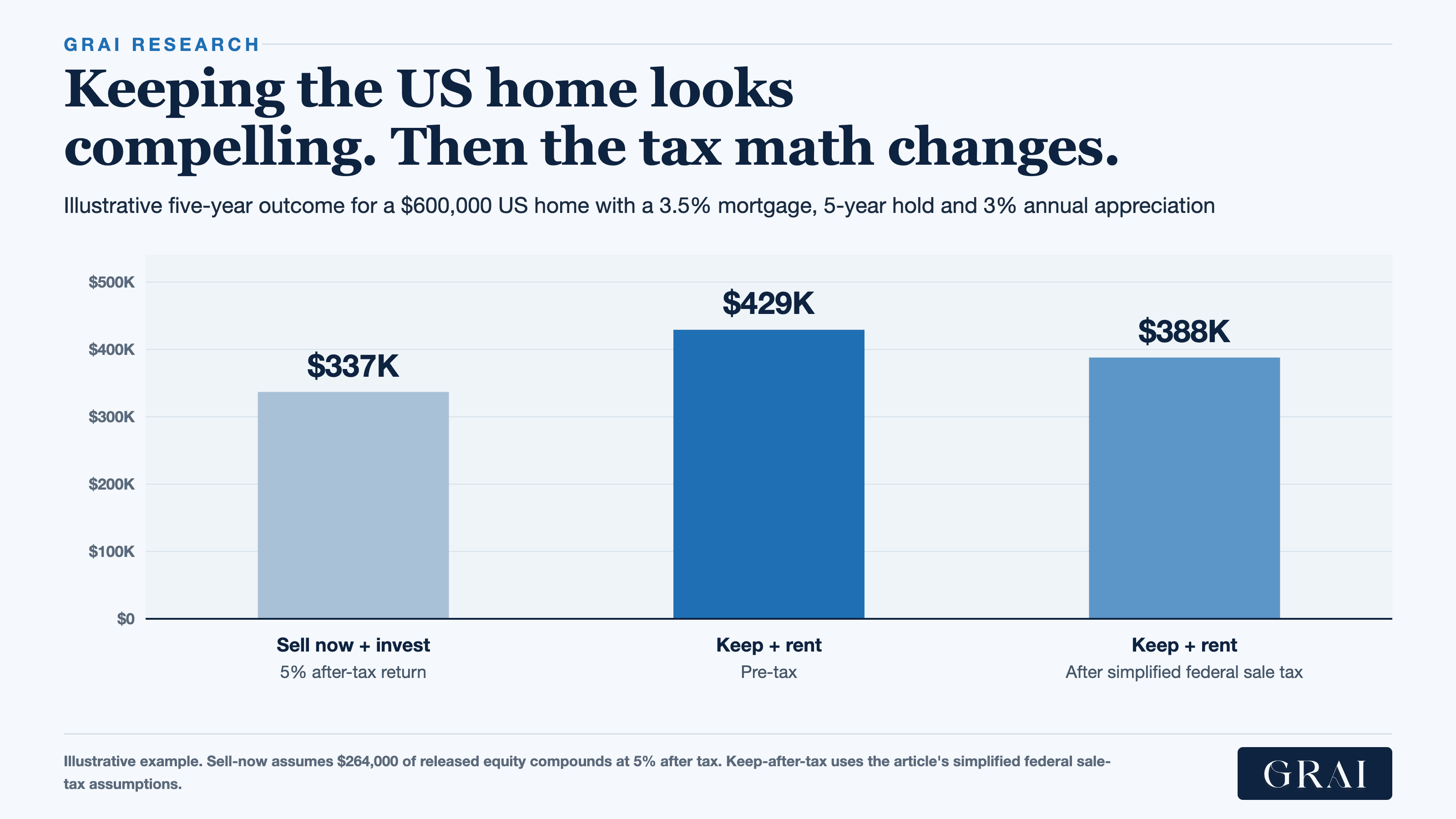
Five-year comparison for an illustrative $600,000 US home. Selling now and investing the proceeds reaches about $337,000, keeping and renting reaches about $429,000 before tax, and about $388,000 after simplified federal sale tax.
After five years, the mortgage balance falls to about $259,000.
At 3% annual appreciation, a $600,000 property would be worth approximately $695,600. After the assumed 6% selling cost, repaying the remaining mortgage and adding five years of $6,866 annual rental cash flow, the pre-tax outcome is approximately $429,000.
That compares with roughly $337,000 from selling now and compounding the released equity at 5% after tax.
A $92,000 gap sounds decisive.
It isn't, because we have not yet introduced the tax consequences of turning the former home into a rental and selling it years later.
Use GRAI to compare your own sell-versus-rent scenarios, including appreciation, cash flow, and tax layers: https://internationalreal.estate/chat
For a nonresident alien, US rental income from real property is generally subject to 30% tax on gross income when it is not treated as effectively connected income. The US–India treaty allows the United States to tax income from US real property and does not provide a reduced rental-income rate in Article 6. A homeowner can instead consider the IRC 871(d) election, which can allow attributable expenses to be deducted and the resulting net income to be taxed under the applicable rules.
IRC 871(d) allows a nonresident owner to elect to treat US real-property income as effectively connected with a US trade or business. That changes the calculation substantially because attributable expenses can then be deducted and the net income is taxed under the applicable rules. The IRS also explains the use of Form W-8ECI with the withholding agent when the income is treated as effectively connected. (IRS)
The distinction is enormous in our example.
Thirty percent of the $43,320 gross collected rent is approximately $12,996 a year.
Yet the property's pre-tax cash flow is only $6,866.
Without the election, assuming the full statutory gross rate applied, federal gross-rent tax alone could turn the property's cash flow from roughly +$6,900 to about -$6,100 a year** before considering other taxes.
With the 871(d) election, the picture can be radically different.
Our property has approximately $24,888 of NOI before financing. Mortgage interest starts at roughly $10,400 in year one and gradually falls. With an approximate $400,000 depreciable building basis, residential rental depreciation has a 27.5-year recovery period. The annual full-year equivalent is about $14,500, although actual first and final year deductions depend on the IRS mid-month convention. (IRS)
Interest plus depreciation therefore absorbs almost all of the illustrative property's NOI for federal taxable-income purposes during these early years.
The economic cash flow and the taxable rental income can look completely different.
That is why the 871(d) question deserves to be answered before a nonresident owner simply hands the property manager a set of keys and assumes the tax treatment will take care of itself.
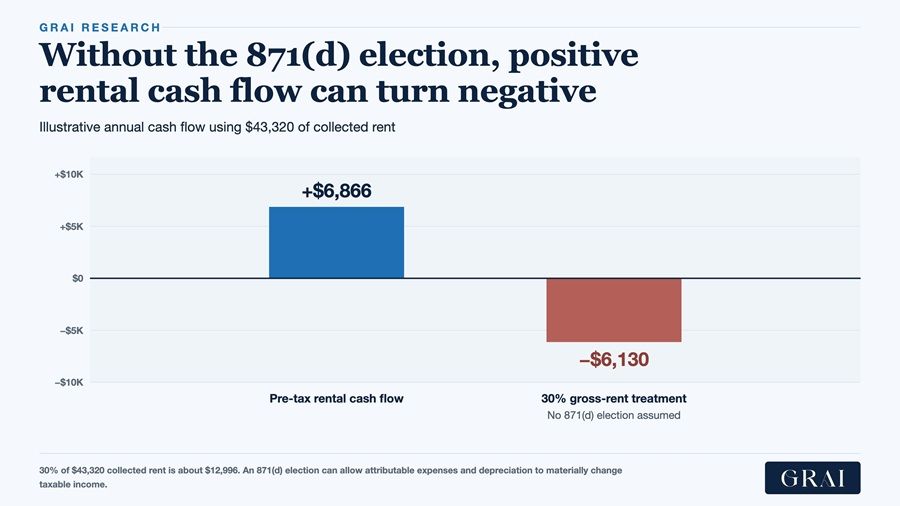
Illustrative US rental cash flow changes from positive $6,866 before tax to negative $6,130 after applying the 30% gross-rent treatment without an IRC 871(d) election.
The house was bought for $500,000, and we have assumed 20%, or $100,000, represents land. Land is not depreciable, leaving approximately $400,000 of building basis.
The IRS says that when a personal residence is converted to rental use, depreciation generally uses the lower of adjusted basis or fair market value at conversion. Residential rental property under the general system uses a 27.5-year recovery period. (IRS)
Using $400,000 as the illustrative building basis produces roughly $14,500 a year of full-year depreciation, or approximately $72,700 over five years as a simplifying estimate. Actual depreciation will depend on the placement-in-service and sale months.
Depreciation reduces the property's adjusted basis. The IRS also makes clear that depreciation allowed or allowable can affect gain even if the owner failed to claim every deduction, and the depreciation-related portion of the gain may be taxed as unrecaptured Section 1250 gain at a maximum 25% rate. (IRS)
That tax cost has to be included in the keep calculation.
Section 121 generally requires the owner to have owned and used the property as a principal residence for at least two of the five years ending on the sale date.
Someone who lived in the home continuously for at least two years immediately before moving to India can therefore often retain eligibility for roughly another three years, assuming the other conditions are satisfied.
There is an important nuance that is frequently misstated. The IRS specifically excludes from “nonqualified use” the period within the five-year window after the last date the property was used as the principal residence. Its own example shows a homeowner moving out, renting the former home and later selling while still qualifying for the exclusion. (IRS)
Depreciation remains separate and cannot simply be sheltered by Section 121.
Our five-year comparison deliberately assumes the household moves to India and does not move back into the property. At the end of five full years, there would generally no longer be two years of principal-residence use inside the five-year lookback window.
The illustrative five-year sale therefore assumes no Section 121 exclusion.
Someone selling closer to year two or three could face a very different after-tax result.
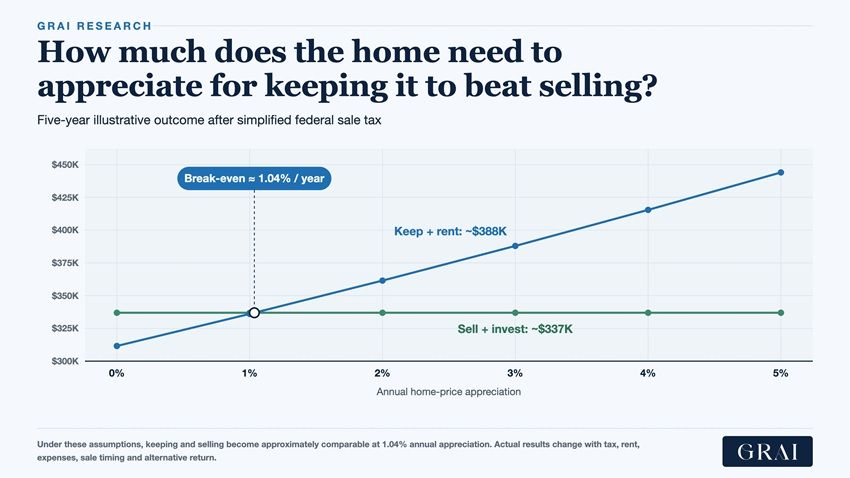
Five-year comparison of keeping versus selling an illustrative US home at zero to 5% annual appreciation. Keeping approximately matches, selling and investing the proceeds at about 1.04% annual home-price appreciation.
At 3% annual appreciation, the property reaches approximately $695,600 after five years.
After 6% selling costs, the illustrative amount realized for gain purposes is about $653,800. Reducing the original $500,000 basis by approximately $72,700 of depreciation leaves an adjusted basis around $427,300.
That produces an illustrative taxable gain of roughly $226,600.
For comparison purposes only, assume the depreciation-related gain is taxed at the maximum 25% unrecaptured Section 1250 rate and the remaining long-term gain at 15%. Actual capital-gains rates depend on the taxpayer's income and circumstances, and other taxes can apply. (IRS)
The illustrative federal sale tax becomes approximately:
$18,200 on the depreciation-related portion
$23,100 on the remaining gain
about $41,300 in total
The pre-tax keep outcome of approximately $429,000 therefore falls to roughly $388,000 after this illustrative federal sale tax, before state tax, Indian tax, passive-loss complications or other personal factors.
Selling today and investing $264,000 at the assumed 5% after-tax annual return still produces about $337,000.
Keeping continues to win in this particular example, but the advantage has fallen from around $92,000 to approximately $51,000.
That is a much more useful result than trying to force the example to prove that selling is better.
Under these assumptions, the property does not need 3% appreciation to justify keeping it. Once the illustrative federal sale tax is included, the approximate break-even appreciation rate is about 1% a year.
Change the rent, tax basis, mortgage rate, sale date, state tax, management costs or alternative return, and that answer moves again.
Related: 5 What-If Scenarios Every Real Estate Investor Must Explore in 2025
Yes.
If the owner is a foreign person for US tax purposes when the property is sold, FIRPTA generally requires the buyer to withhold 15% of the amount realized.
On the illustrative $695,600 sale, that would be roughly $104,300. (IRS)
Our simplified federal sale-tax estimate was only about $41,300.
That does not mean the seller ultimately owes $104,300. FIRPTA is a withholding mechanism, not necessarily the final tax bill.
There is also a reduced 10% withholding rate when an individual buyer acquires a qualifying property for use as a residence and the amount realized is above $300,000 but no more than $1 million. At our sale price that would be about $69,600, assuming the residence requirements are satisfied. (IRS)
Even the reduced number is substantially larger than the illustrative final federal tax.
The IRS can issue a withholding certificate where the normal withholding would exceed the seller's maximum tax liability, and Form 8288-B can be used in qualifying circumstances to request reduced or eliminated withholding. (IRS)
For a family relocating to India, that can become a liquidity issue rather than merely a tax issue. Having tens of thousands of dollars temporarily withheld can affect a home purchase, school fees or investment plans in India even if much of the money is eventually refunded.
The property decision is denominated in dollars, but the family's next chapter may be denominated in rupees.
Selling today releases approximately $264,000 in our example. A hypothetical 5% movement in the dollar's value against the rupee changes the INR value of those proceeds by the equivalent of about $13,200.
That is almost twice the property's annual pre-tax rental cash flow.
This is not an argument for trying to forecast currencies. It means the homeowner should decide whether the sale proceeds are intended to remain invested in dollars or fund expenses and assets in India.
A sell-versus-rent model for someone permanently relocating to India is incomplete if it compares only dollar returns while ignoring the currency in which the money will eventually be spent.
Indian tax treatment depends heavily on the homeowner's residential status in the year concerned.
The Income Tax Department distinguishes between Resident and Ordinarily Resident (ROR), Resident but Not Ordinarily Resident (RNOR), and Non-Resident (NR). An ROR is generally taxable in India on foreign income as well as Indian income. RNORs and non-residents are generally not taxed in India on ordinary foreign-source income that has no Indian business or professional connection.
That distinction also affects reporting. Schedule FA is used to disclose foreign assets and foreign-source income, including immovable property outside India, but the Income Tax Department states that Schedule FA need not be completed by taxpayers who are RNOR or non-resident.
For someone who has become ROR by the time the US home is sold, the eventual gain can also enter the Indian tax calculation because foreign-source income is generally within the Indian tax base for an ROR. The US may tax the same sale under its own rules, but the US-India tax treaty provides relief from double taxation: where an Indian resident derives income that may be taxed in the United States, India allows credit for qualifying US income tax, subject to Indian law and treaty limits. India's Rule 128 similarly provides foreign tax credit for qualifying foreign tax paid on income that is also offered to tax in India.
The practical consequence is that the owner's status in the actual sale year matters. A homeowner who sells while still RNOR can face a different Indian tax result from one who waits until becoming ROR. The same property can therefore have different after-tax economics depending not only on the sale price, but also on when the owner moves back to India and how long they hold the house afterward.
This is one of the places where the US and Indian calculations should be reviewed together rather than optimized separately.
The example above demonstrates why there is no automatic answer.
A 3.5% mortgage is valuable. Someone who borrowed during the low-rate period may be giving up financing that is difficult to replace. If the home rents well, the owner has sufficient liquidity elsewhere and professional management is reliable, keeping the asset can remain financially attractive.
Selling becomes more compelling as the economics move in the opposite direction. A high amount of equity earning, weak cash flow, expensive management, a poor rent-to-value ratio, an approaching Section 121 deadline, strong alternative uses for the capital or a household that simply does not want another country's property problems can shift the answer.
The useful number is not whether rent covers the mortgage.
It is the return being earned on the equity that could otherwise be released, after tax and after the costs of running the property from India.
Write down the exact property numbers. Mortgage balance, monthly payment, tax, insurance, HOA, realistic rent and realistic sale value are enough to build the first comparison.
Check the mortgage and HOA before promising the house to a tenant. Confirm any occupancy covenant, lease restriction, minimum lease term or rental cap.
Record the date you stopped using the house as your principal residence. That date can become important for the Section 121 two-of-five calculation.
Speak with the insurer before the occupancy changes. Vacant, owner-occupied and landlord risks are not interchangeable.
Put somebody credible on the ground. A property manager, attorney, agent or appropriately authorized person should be able to inspect the home, receive notices and respond to urgent problems.
Make the property remotely visible. Secure mail forwarding, cameras or alarm monitoring where appropriate, leak detection and reliable access for inspections and repairs.
Work out how long you can afford to hold it empty. In our example, six months of basic carrying costs already exceeds $15,000 before utilities, repairs and potentially higher vacancy-related insurance costs.
If the mortgage is becoming unaffordable, contact the servicer before disappearing. Current CFPB guidance lists possibilities including repayment plans, modification, forbearance, short sale and deed-in-lieu depending on the loan and circumstances.
A deed-in-lieu is particularly different from abandonment. It is a negotiated transfer of ownership to the lender, and the CFPB recommends confirming in writing whether the arrangement covers the entire outstanding mortgage and any deficiency.
An urgent departure from America does not require an uncontrolled exit from the property.
The five-year example is intentionally synthetic. A real homeowner should substitute their own figures and test more than one future.
Useful GRAI prompts would be:
“Compare selling my US home now with renting it for five years using my actual mortgage balance, interest rate, property tax, insurance, HOA, rent, vacancy, management cost and selling costs.”
“How much does my home need to appreciate for keeping it five years to beat selling, after my Section 121 timing, depreciation and nonresident rental tax treatment?”
“I may have to move to India within 30 days. Compare selling, renting remotely and holding the house vacant for six months, and show the cash required and biggest risks of each.”
“Stress-test keeping my home if rent falls 10%, vacancy reaches two months a year, I have a $15,000 repair in year two and the dollar weakens 5% against the rupee before I transfer the money to India.”
GRAI can structure and stress-test the property decision using the homeowner's actual mortgage, equity, rent and costs, while flagging the tax, legal and immigration questions that need verification by a qualified professional.
For the earlier H-1B homeowner framework, including FIRPTA and Section 121, see What Happens to Your Home If You Lose Your H-1B Job?. For the employment-market context, including the 89-market comparison and the unusually sharp DFW decline, see Will H-1B Visa Changes Affect Home Prices? What 89 US Markets Show.
Ask GRAI to build a full US-to-India property model with Section 121 timing, FIRPTA, and INR conversion built in: https://internationalreal.estate/chat
For the synthetic homeowner in this article, keeping the property still comes out ahead after five years if the home appreciates around 3% a year, the 3.5% mortgage remains in place, the rental assumptions hold and the owner handles the nonresident tax treatment properly.
But the margin is much smaller once the missing tax layers are included.
The pre-tax keep outcome is about $429,000, compared with roughly $337,000 from selling today and investing the released equity at an assumed 5% after tax. After the simplified federal sale-tax assumptions used in this example, the keep outcome falls to about $388,000.
That still leaves keeping ahead by roughly $51,000 in this particular scenario.
At zero appreciation, however, the after-tax keep outcome falls to about $312,000, below the sell-and-invest alternative. Under the same assumptions, keeping and selling become approximately comparable at around 1.04% annual home-price appreciation.
That is the more useful result.
The house does not need spectacular appreciation to justify keeping it, especially with a 3.5% mortgage. But the answer is no longer obvious once the homeowner accounts for nonresident rental tax, depreciation, the Section 121 clock, eventual sale tax, FIRPTA cash-flow withholding, possible Indian taxation and the cost of managing the property from another country.
The same house can even show positive cash flow under ordinary rental math and negative cash flow under the default nonresident gross-rent treatment if the owner never addresses the 871(d) election.
And none of these numbers captures the value of having $264,000 of liquid capital available immediately while rebuilding a life in India, or the effect of converting those dollars into rupees at a favorable or unfavorable exchange rate.
There is therefore no universal rule that says a low-rate US mortgage should always be kept, just as there is no rule that says someone moving back to India should always sell.
The decision becomes much clearer once the homeowner knows exactly what the property has to earn, appreciate by and survive operationally in order to beat selling it today.
No. Moving abroad does not change the mortgage obligation or transfer ownership to the lender. If payment becomes difficult, contacting the servicer early can open loss-mitigation options that are very different from simply stopping communication. (Consumer Financial Protection Bureau)
Ordinary civil mortgage foreclosure is not listed as an automatic visa-ineligibility ground. Fraud, criminal conduct, drug violations and unlawful presence are separate immigration issues and can have much more serious consequences. (Travel.state.gov)
Potentially, yes. Once a creditor has a judgment, US law can provide stronger collection tools including bank-account garnishment and liens, subject to applicable exemptions and state procedures.
There is no nationwide 30-day rule transferring ownership. Occupancy and eviction law varies by state and city. In jurisdictions such as California, even occupants who are not named on a lease can become involved in formal possession proceedings.
Not simply because the rental happens after you move out. IRS Publication 523 expressly excludes certain post-residence periods within the five-year window from the nonqualified-use calculation. You still need to satisfy the ownership and two-of-five use tests, and depreciation remains separately taxable. (IRS)
No. Fifteen percent is the general withholding rate, but qualifying residence purchases between $300,000 and $1 million can use a 10% rate, and IRS withholding certificates can reduce or eliminate withholding in qualifying situations. (IRS)
It depends on their Indian residential status.
The Income Tax Department says Schedule FA includes foreign assets such as overseas immovable property, but it does not need to be completed by taxpayers who are RNOR or non-resident. Once the homeowner is Resident and Ordinarily Resident, foreign assets generally fall within Schedule FA reporting and ordinary foreign-source income is generally within the Indian tax base.
If the US property is later sold while the owner is ROR, the gain may therefore also need to be reported in India. Qualifying US income tax paid on the same income can generally be considered for foreign tax credit under the US-India treaty and India's Rule 128, subject to the applicable limits and filing requirements.
Research note: The numerical example is illustrative and deliberately simplifies state tax, Indian tax, passive-activity limitations, exact depreciation conventions, changing rent and expenses, and individual filing circumstances. It is designed to show how the decision changes as additional layers are introduced, not to calculate a particular homeowner's tax return.


