Ask GRAI Anything
Your Real Estate Questions, Answered Instantly via Chat

Help us make GRAI even better by sharing your feature requests.
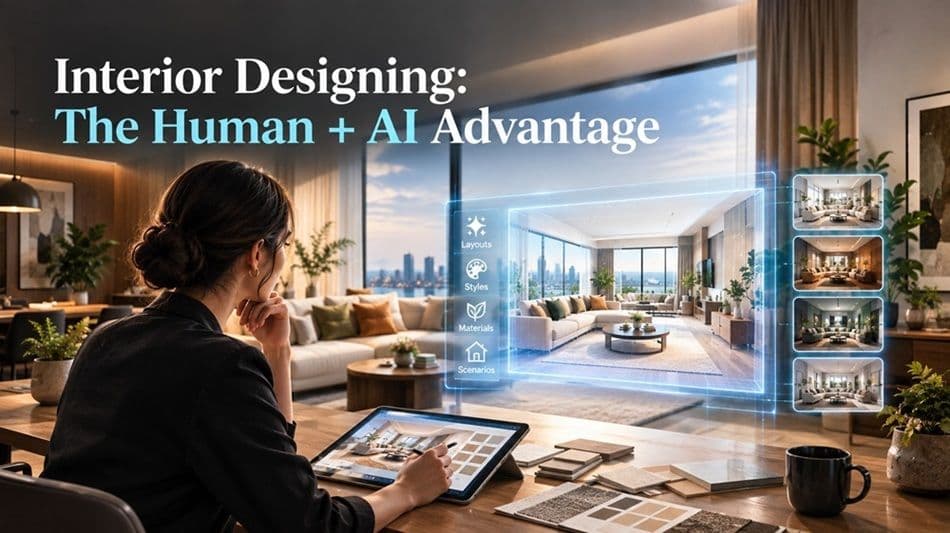
Interior design has always been a negotiation between imagination and reality.
A designer imagines what a space could become. A client imagines how they will live in it. Budgets, materials, dimensions, construction constraints, local culture, climate, and property value determine what actually happens.
AI is changing where that process begins.
Instead of moving from a brief to a single concept and then iterating manually, designers can now explore multiple possibilities, visualize changes, test different layouts, and examine a property's potential much faster.
But the real opportunity isn't AI replacing designers. It is human creativity combined with AI intelligence.
The designers who understand this distinction can use AI not simply to generate attractive rooms, but to make better decisions about spaces, properties, budgets, and client needs.
Traditional interior design often follows a relatively linear process.
A client provides a brief. The designer develops a concept. Visual references are created. Materials are selected. Layouts are refined. The client provides feedback. The process continues until everyone agrees on a direction.
AI introduces a different possibility. Instead of starting with one concept, designers can explore a design space.
What happens if the living room becomes more minimalist?
What if the same space is optimized for entertaining?
What if it needs to work as both a home office and guest room?
What if the property is being prepared for rental rather than owner occupation?
What if the design needs to appeal to a different buyer demographic?
AI can help visualize these alternatives quickly. The designer's role then shifts from simply creating one solution to understanding which possibilities deserve serious consideration.
One of AI's biggest advantages in design is speed.
A designer can explore different combinations of:
Layouts
Furniture
Materials
Lighting
Color palettes
Architectural styles
Interior finishes
Functional configurations
This does not mean every AI-generated concept should become a real design. The value is in exploration.
Instead of spending significant time visualizing every alternative manually, designers can use AI to identify promising directions and then apply professional judgment to refine them.
That creates a new workflow:
Explore
Compare
Refine
Validate
Design
The technology accelerates exploration. The designer determines what is worth pursuing.
As AI makes visual experimentation easier, creativity does not become less important.
In some ways, it becomes more important. When generating a concept becomes easier, the difficult question becomes:
Which concept is actually right?
A client may have dozens of visually attractive options. A designer needs to understand which one reflects the client's lifestyle, budget, property, personality, and long-term objectives.
This requires judgment.
It requires understanding proportions, materials, construction realities, human behavior, cultural context, and the emotional experience of a space.
AI can generate possibilities. A designer gives those possibilities meaning.
There is an important difference between an AI that creates attractive interiors and an AI that understands the context surrounding a property.
A design that works beautifully in Dubai may not be appropriate for Bali.
A concept designed for a London apartment may not translate directly to a Mumbai home.
Climate, architecture, household structures, materials, lifestyle, cultural preferences, construction costs, and intended property use can all influence the right design direction.
This is where contextual AI becomes more valuable.
Instead of asking only:
“Make this room look better.”
The more useful question becomes:
“How should this space be designed given where it is, who will use it, what they value, and what the property is intended to achieve?”
That distinction moves AI design from image generation toward property intelligence.
Traditional design briefs describe what the client wants.
AI can help expand the brief into a much broader set of contextual inputs.
For example:
Property: Apartment in a major urban market
Climate: Hot and humid
Users: Young professional couple
Objective: Primary residence
Budget: Mid-to-high renovation budget
Style: Contemporary, warm minimalism
Constraint: Limited floor area
Priority: Flexible work-from-home space
Long-term consideration: Resale appeal
These inputs can create a much more meaningful starting point for design exploration.
The AI does not replace the designer's interpretation.
It gives the designer more context to work with.
Related: How Contextual Designs with GRAI Are Helping Interior Designers Win More Projects
One of the most interesting changes AI introduces is the ability to think in scenarios.
A designer can ask:
What if the client wants to live here?
Then:
What if the property becomes a rental?
Then:
What if the owner sells in five years?
Then:
What if the second bedroom needs to become a workspace?
Each scenario can influence the design differently.
This turns interior design into more than aesthetic decision-making.
It becomes an exercise in understanding how a property might evolve.
That is particularly valuable in real estate, where spaces are rarely static.
Use GRAI to compare live-here, rent-out, and sell-in-five-years design scenarios for any property in minutes: https://internationalreal.estate/chat
There is also a potential contradiction in AI-powered design.
AI can create enormous variety, but widespread use of similar AI systems could also produce visual sameness.
If everyone asks for “luxury modern,” the results can begin to look remarkably similar.
This is where human creativity matters.
Designers bring references that are not necessarily obvious from a prompt. They understand cultural nuance. They know when a combination feels unexpected but right. They can combine materials, traditions, proportions, and personal stories in ways that make a space distinctive.
AI can expand the design canvas.Humans decide what belongs on it.
The strongest interior design workflows will combine several capabilities.
AI brings:
Speed
Visualization
Iteration
Pattern recognition
Scenario exploration
Context processing
Humans bring:
Taste
Empathy
Creativity
Cultural understanding
Professional judgment
Client relationships
Practical experience
Neither side needs to perform the other's role. The advantage comes from combining them.
A designer who understands how to direct AI effectively can potentially explore more possibilities while spending more time on the parts of the process where human expertise matters most.
This is where the relationship between interior design and real estate intelligence becomes particularly interesting.
GRAI isn't a generic AI image generator; it is built for real estate, creating contextual visualizations around a property's characteristics, location, design potential, and intended use.
It can help users look at a property from multiple perspectives - its location, potential use, design possibilities, costs, investment considerations, and broader market context.
For a designer, that means the question can move beyond:
“What could this property look like?”
toward:
“What could this property become, and which transformation makes sense for its intended purpose?”
That distinction is important because design decisions can influence more than appearance.
They can affect usability, rental appeal, buyer perception, renovation costs, and potentially the broader investment case.
Ask GRAI to generate contextual interior concepts tied to location, use, and renovation costs before you start designing: https://internationalreal.estate/chat
The most important shift may happen beyond interior design itself. Historically, property analysis and design have operated in separate silos.
Investors evaluate:
Price
Rent
Yield
Financing
Location
Designers evaluate:
Space
Materials
Aesthetics
Circulation
Functionality
But property value is influenced by both.
A poorly designed property can be difficult to rent.
An intelligently renovated property can become more attractive.
A flexible layout can expand the potential buyer pool.
A climate-inappropriate design can increase maintenance costs.
A dated interior can create psychological resistance even when the underlying property is sound.
The future therefore isn't simply AI-generated interiors.
It is the convergence of:
Property intelligence + design intelligence + economic intelligence.
That is a much bigger category.
A beautiful redesign is only one part of a property decision. For investors, developers, and buyers, another question matters:
Does the proposed improvement actually make economic sense?
A renovation may improve the appearance and functionality of a property, but its financial impact depends on factors such as renovation costs, expected rent, operating expenses, financing, market conditions, projected cash flow, and the property's investment objectives.
This is where GRAI's AI Real Estate Deal Report can connect design thinking with investment analysis.
Instead of evaluating a property purely through visuals, users can examine financial factors such as rental income, cash flow, DSCR, risk flags, assumptions, scenarios, and cited sources.
The workflow becomes:
Property
Design possibilities
Renovation implications
Financial analysis
Investment decision
AI-generated design helps answer:
“What could this property look like?”
Deal intelligence helps answer:
“What does this property potentially look like as an investment?”
Together, they create a broader decision framework.
The most interesting future of interior design is not a world where every room is designed by an algorithm. It is a world where designers have better tools to understand possibilities.
A property could be explored through multiple versions:
Live here
Optimized for their household and lifestyle.
Rent it
Optimized for durability, tenant appeal, and operational efficiency.
Sell it
Optimized around broad buyer appeal and presentation.
Work here
Optimized for remote work and adaptable spaces.
The physical property hasn't changed.
The intelligence surrounding it has.
This could fundamentally change how people perceive real estate.
Age here
Optimized for accessibility, comfort, and long-term usability.
Each scenario can produce different design requirements.
AI makes those scenarios easier to visualize and compare.
Human expertise determines which ones are actually meaningful.
The competitive advantage for interior designers is therefore unlikely to come from simply knowing how to generate AI images. That capability is becoming increasingly accessible. The greater advantage comes from combining:
Human taste + AI experimentation + property intelligence + construction knowledge + client empathy
A designer who can move between these disciplines can become more than a person who creates beautiful interiors.
They can become a strategic advisor for how a space should function, evolve, and potentially contribute to the value of a property.
The debate around AI in creative industries often focuses on replacement.
Interior design offers a more useful perspective:
AI can make visualization faster.
It can make experimentation cheaper.
It can help designers explore more scenarios.
It can bring more context into early-stage decision-making.
But human designers remain responsible for taste, empathy, cultural understanding, professional judgment, and the connection between an idea and the reality of a client's life.
The opportunity is not to choose between human creativity and artificial intelligence. It is to combine them.
The strongest interior design workflow is not AI alone. It is human creativity amplified by AI intelligence.
Evaluate your next interior project as both a living space and an investment with GRAI’s human+AI workflow: https://internationalreal.estate/chat
AI is more likely to change how interior designers work than eliminate the profession. AI can accelerate visualization, generate design variations, analyze context, and explore scenarios, while designers provide creative direction, taste, empathy, cultural understanding, and professional judgment.
AI can make interior design more iterative and data-informed. Designers can explore multiple layouts, materials, styles, budgets, and use cases faster, allowing clients to compare possibilities before committing to construction or renovation.
Contextual AI design goes beyond generating an attractive image. It considers factors such as the property's location, climate, architecture, intended use, local preferences, materials, costs, and potential rental or resale objectives when exploring design possibilities.
Yes. AI can help homeowners explore potential changes to layouts, interiors, finishes, furniture, and other design elements before work begins. These visualizations can make renovation possibilities easier to understand and discuss with designers, architects, and contractors.
AI can reduce time spent on repetitive visualization and early-stage exploration. Designers can use it to generate alternatives, test different concepts, communicate ideas visually, and explore client scenarios before refining the final design through professional expertise.
Design analysis can become one input into an investment decision by showing how a property might be adapted for different uses. However, design potential alone does not establish financial viability. Investors should also consider costs, income, financing, market conditions, risks, and other relevant assumptions.
An AI Real Estate Deal Report brings property investment analysis into a structured report. GRAI's report can examine factors such as rental income, cash flow, DSCR, risk flags, assumptions, scenarios, and cited sources, helping users evaluate the financial side of a property alongside its potential design opportunities.
GRAI can connect design exploration with broader property analysis. Instead of asking only, “What could this property look like?”, users can also explore questions such as, “What could this renovation mean for the property's investment case?” This creates a broader workflow from property analysis to design possibilities and financial evaluation.
AI can make personalization faster by allowing designers and clients to explore different scenarios based on lifestyle, preferences, property characteristics, budget, and intended use. Human designers remain important for determining which ideas are appropriate and achievable.
The advantage comes from combining human expertise with AI experimentation. Designers who can use AI to explore possibilities while applying strong creative judgment, client understanding, material knowledge, and practical experience can turn a large number of generated options into meaningful design decisions.
AI is changing interior design by making visualization, experimentation, contextual analysis, and scenario planning faster and more accessible. But technology does not eliminate the value of human designers. It increases the importance of judgment, taste, empathy, cultural understanding, and professional expertise. With platforms such as GRAI connecting contextual design with broader real estate intelligence and financial analysis, interior design can increasingly become part of a larger property decision-making workflow.
For homeowners, investors, developers, architects, and designers, the opportunity is therefore not simply to generate more images. It is to make better property decisions by connecting design, context, economics, and human experience.
The winning model will not be Human or AI.
It will be Human + AI.
And the designers who learn how to use that combination intelligently may define what the next decade of real estate looks like.


