Ask GRAI Anything
Your Real Estate Questions, Answered Instantly via Chat

Help us make GRAI even better by sharing your feature requests.

Your US savings can buy very different lives in India. We compare 12 returnee markets, the residential corridors families actually shortlist, and GRAI's Liveability Index across housing, schools, careers and financial runway.
The neighbourhood that scored best for a returning family is also the one that leaves almost no money behind.
In GRAI's profile-specific comparison, Whitefield in Bengaluru ranked first for family liveability (8.5/10) and schools (9.0/10). But at a median 3BHK asking price of about ₹2.30 crore plus purchase costs, it leaves a family arriving with ₹2.55 crore with roughly ₹9 lakh, under four months of family spending.
Kokapet / Financial District in Hyderabad scored highest for career access (9.5) and commute, and Sector 150 in Noida highest for housing value.
The same ₹2.55 crore buys a typical 3BHK in Kakkanad, Kochi, and still leaves about ₹1.48 crore, close to five years of runway. In Sector 150, Dwarka, Golf Course Extension Road and Powai, it does not cover the median 3BHK at all.
There is no single best city. There is a trade-off between the life you want to live and the freedom you want to keep. For many returnees, the smartest first move is 8renting for 6-12 months before buying anything*.
How Much Does Your US Home Equity Buy in India?
Which Indian Cities Are Best for People Moving Back From the US?
Bengaluru vs Hyderabad vs Pune: Which Gives Returnees the Best Balance?
Delhi vs Gurugram vs Noida: Where Should a Returning Family Live?
Are Coimbatore, Kochi and Mysuru Better Than Tier 1 Cities for Returnees?
Is Goa a Good Place to Live After Moving Back From the US?
Can You Still Build a Tech Career Outside Bengaluru, Hyderabad and Chennai?
Should You Buy a Home Immediately After Moving Back to India?
How Long Will Your US Savings Last After Moving Back to India?
Which Indian City Has the Best Quality of Life for a Returning Family?
Which Indian City Is Best for Your Type of Return?
How Can GRAI Compare Your Move Back to India?
₹2.55 crore buys a good 3BHK in Kochi and leaves well over a crore untouched. In Gurugram or Mumbai, it may not buy a typical 3BHK at all.
That is the financial-reset problem in two sentences.
In the previous article in this series, our illustrative US homeowner released about $264,000 after selling the home, paying selling costs and clearing the mortgage. At the rupee's close of about ₹96.73 per dollar on October 9, 2026, that is roughly ₹2.55 crore.
City averages hide too much, so we looked at the residential corridors a returning family would realistically shortlist. The figures below are median 3BHK asking prices from current online listings, which reduces distortion from a few unusually expensive homes.
| Returnee market | Representative corridor | Median 3BHK asking price | Does ₹2.55cr cover it? |
|---|---|---|---|
| Kochi | Kakkanad | ~₹1.00cr | Yes |
| Coimbatore | Saravanampatti | ₹0.79-1.40cr (listed range) | Yes |
| Mysuru | City-wide* | ~₹1.25cr | Yes |
| Chennai | Sholinganallur | ~₹1.36cr | Yes |
| Pune | Kharadi | ~₹1.75cr | Yes |
| Goa | Porvorim | ~₹2.00cr | Yes |
| Bengaluru | Whitefield | ~₹2.30cr | Barely |
| Hyderabad | Kokapet | ~₹2.31cr | Barely |
| Noida | Sector 150 | ~₹2.59cr | No |
| Delhi | Dwarka | ~₹2.85cr | No |
| Gurugram | Golf Course Extension Road | ~₹3.49cr | No |
| Mumbai | Powai | ~₹4.53cr | No |
*Mysuru is shown city-wide because locality-level listing samples are too thin for a reliable median. Source: Magicbricks 3BHK listings by locality, October 2026.
Two caveats matter. These are asking prices, not completed sales. And a "3BHK" is not the same home everywhere: unit sizes, building age and amenities differ by corridor, so a premium-corridor 3BHK is often a larger, higher-spec home. The table is not a like-for-like valuation. It shows how quickly the same US equity changes character once it lands in a real neighbourhood.
Run your own number: a family arriving with ₹1.5 crore has a different shortlist from one arriving with ₹3 crore or ₹5 crore. The question is not "What can I afford?" It is "What will I have left after I buy it?"
The returnee who needs another senior AI or product role is solving a different problem from someone who works remotely and wants to live near ageing parents.
This comparison covers 12 markets: Bengaluru, Hyderabad, Pune, Chennai, Mumbai, Delhi, Gurugram, Noida, Coimbatore, Kochi, Mysuru and Goa. They fall into four groups:
Career-heavy metros: Bengaluru, Hyderabad, Pune, Chennai and Mumbai.
NCR, split three ways: Delhi, Gurugram and Noida behave like three different markets, not one.
Capital-efficient alternatives: Coimbatore, Kochi and Mysuru, for households with portable careers.
Lifestyle and founder option: Goa.
Tenkasi sits outside the ranking as a case study, because it asks a different question: does a technology professional still need a Tier 1 city at all?
Bengaluru still has the strongest case when maximum technology-career optionality matters more than housing cost.
The GCC data supports that. Global Capability Centres leased a record 9.1 million sq ft of office space in Q1 2026, the highest quarter on record, with Bengaluru and Hyderabad driving the activity as per a CBRE report. CBRE's later GCC policy report found that states with GCC-focused policies are collectively targeting more than 1,300 new centres and over 1.1 million jobs by 2031.
But premium tech corridors are no longer cheap. The median 3BHK asking price is about ₹2.30 crore in Whitefield, ₹2.31 crore in Kokapet and ₹1.75 crore in Kharadi.
GRAI's comparison adds the liveability layer. For a US-returning family with school-age children and a senior technology professional:
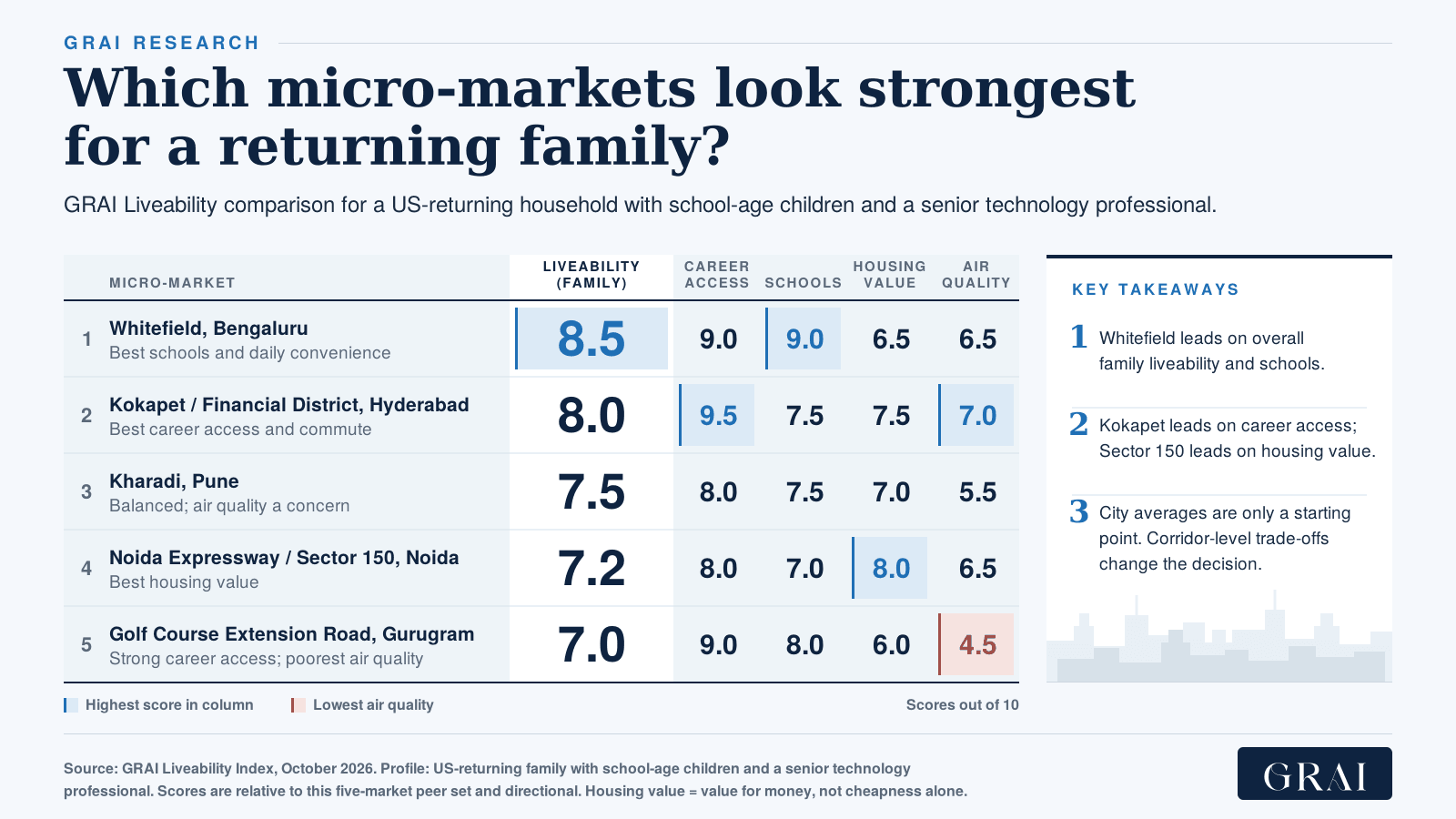
Whitefield ranked first overall at 8.5/10. It had the highest schools (9.0), healthcare (8.5) and daily-convenience (9.0) scores in the set. Its weak spot is commute and traffic, the lowest in the set at 6.0.
Kokapet / Financial District ranked second at 8.0, with the highest career and tech-access score of the five (9.5). It also beat Whitefield on commute (8.0), airport connectivity (8.0) and housing value (7.5).
Kharadi ranked third at 7.5. It scored well on airport connectivity (8.0) and daily convenience (8.0), but air quality (5.5) held it back.
These are relative scores within a five-market peer set for one family profile, not ratings for the whole city.
The practical takeaway: Kokapet and Whitefield now carry almost identical median asking prices, so Hyderabad's edge is no longer cheaper premium housing. It is roads, airport access and career depth. Whitefield's edge is the family setup: schools, hospitals and daily convenience a family landing from overseas can use from week one.
Pune offers a lower entry point. Kharadi's median sits roughly ₹55 lakh below Whitefield's, which buys about two extra years of runway in the calculation in Section 9.
"NCR" is too broad to be useful for a household decision.
Delhi is often about family roots and established neighbourhoods. Gurugram is the corporate-career choice. Noida usually offers more space for the money. The price gaps are large: the median 3BHK asking price is about ₹2.85 crore in Dwarka, ₹3.49 crore on Golf Course Extension Road and ₹2.59 crore in Sector 150. None is covered by ₹2.55 crore.
In GRAI's comparison, Noida Expressway / Sector 150 scored 7.2 and Golf Course Extension Road 7.0. The two traded places on the dimensions that matter most:
GCER scored strongly on schools (8.0), airport connectivity (8.5), daily convenience (8.5) and career access (9.0). But it had the lowest air-quality score in the set (4.5) and the lowest housing-value score (6.0).
Sector 150 had the highest housing-value score (8.0) and tied GCER for airport connectivity (8.5). It trailed on schools (7.0) and daily convenience (6.5, the lowest in the set).
One detail is worth reading carefully. Sector 150's median 3BHK asking price is higher than Whitefield's, yet it tops the value score. GRAI scores value as what you get for the money, not the ticket price, and its assessment credits Sector 150 with larger units and township amenities. A median price says nothing about unit size.
Noida also gained a new infrastructure variable this year. Noida International Airport began commercial operations on June 15, 2026, starting with domestic routes. Its interim CEO said international services would begin towards the end of the year.
None of that overrides geography. For a family with an office in Gurugram and parents in South Delhi, Sector 150 can be the wrong answer whatever the spreadsheet says.
For households with portable careers, often yes.
A typical 3BHK in Kakkanad, Kochi's technology corridor, has a median asking price of about ₹1 crore. Saravanampatti in Coimbatore lists 3BHKs between roughly ₹79 lakh and ₹1.4 crore. Mysuru's city-wide 3BHK median is about ₹1.25 crore, although its listing sample is much thinner than the metros'.
Any of the three leaves more than ₹1 crore untouched after purchase costs, against roughly ₹9 lakh in Whitefield and a shortfall on Golf Course Extension Road.
The trade-off is career depth. CBRE's GCC research still treats the Tier 1 hubs as the core of India's GCC market, while tracking Tier II cities as an emerging layer of GCC operations. State policy is moving the same way: Tamil Nadu has introduced specialised incentives for GCC employees, and Kerala has proposed a draft GCC policy.
For a senior executive who needs several competing employers within commuting distance, Bengaluru or Hyderabad can still justify the premium. For a remotely employed family with roots in Kerala or Tamil Nadu, Kochi or Coimbatore offers something the big metros cannot: own the home outright, keep more than a crore in the bank, and stop optimising every career decision for income alone.
Use GRAI to compare Kochi, Coimbatore and Mysuru on career depth, housing cost and leftover runway: https://internationalreal.estate/chat
Goa belongs in this comparison, but not because it is cheap.
In Porvorim, the median 3BHK asking price is about ₹2 crore, more than Kharadi and close to Whitefield. Unit sizes vary by corridor, so part of that gap may reflect larger homes, but the conclusion holds: Goa is not the low-cost reset many people imagine.
The Goa case is about choosing a different version of work and life. The state's 2025 startup policy aims to make Goa a leading startup destination by 2028, with targets including 1,000 startups and 10,000 startup jobs.
That makes Goa credible for founders, consultants and globally employed remote professionals. Someone who needs a dense domestic employer market, many international schools and specialist hospitals nearby will usually be better served by Bengaluru or Hyderabad. Someone with portable income may decide Goa's lifestyle is worth paying for. Goa works when the trade-off is deliberate, not romanticised.
Zoho's Tenkasi operation makes this a real question rather than a theoretical one.
Zoho's careers site lists Tenkasi alongside Chennai, Singapore, Texas and Dubai as one of its work locations.
Tenkasi should not be ranked against Bengaluru as if the two offered the same employment ecosystem. They do not. Its value is conceptual: a serious technology career no longer automatically requires living in the largest possible metro.
For some returnees, that opens a third path. Live near parents, buy more space, lower the family's burn rate and stay plugged into meaningful work. The cost is real too: fewer employers, thinner specialist healthcare and schooling, and weaker international connectivity. That makes the decision far more dependent on one specific job.
Even if you can afford to buy outright, renting first is often the more rational decision.
The first year after an international move is when a family knows least about the life it is building. The school that looked perfect online may mean a punishing commute. The office may land on the other side of the city. A neighbourhood that felt ideal on a two-week visit can feel very different after one monsoon or one NCR winter.
Here is what a year of that information costs:
| Corridor | Furnished 3BHK rent (monthly) | Annual rent | Share of ₹2.55cr |
|---|---|---|---|
| Kakkanad | ₹42,250 | ~₹5.1L | ~2.0% |
| Sector 150 | ₹47,500 | ~₹5.7L | ~2.2% |
| Kharadi | ₹60,750 | ~₹7.3L | ~2.9% |
| Whitefield | ₹82,000 | ~₹9.8L | ~3.9% |
| Kokapet | ₹94,000 | ~₹11.3L | ~4.4% |
| Golf Course Extension Road | ₹1,19,500 | ~₹14.3L | ~5.6% |
Source: Magicbricks Q1 2026 furnished 3BHK rental indicators by locality. These are trend indicators, not quotes for a specific building.
Even in the most expensive corridor, a year of rent costs under 6% of the starting capital. Buying the wrong ₹2-4 crore home costs far more to undo.
Rent is not wasted money here. It is the price of keeping the right to change your mind.
This is where "financial reset" becomes something you can measure.
Start with ₹2.55 crore. Add a standardised 7% purchase-cost reserve to each home price so the comparison does not pretend the asking price is the full cost. This is a normalisation, not the stamp-duty rate in any specific state; replace it with your real local costs. Then assume ₹30 lakh a year of non-housing family spending, with no investment returns, inflation or new income.
| Corridor | Median 3BHK asking price | Capital left after 7% reserve | Runway at ₹30L/year |
|---|---|---|---|
| Saravanampatti | ₹0.79-1.40cr | ₹1.06-1.71cr | 3.5-5.7 years |
| Kakkanad | ₹1.00cr | ₹1.48cr | 4.9 years |
| Mysuru (city-wide) | ₹1.25cr | ₹1.22cr | 4.1 years |
| Sholinganallur | ₹1.36cr | ₹1.10cr | 3.7 years |
| Kharadi | ₹1.75cr | ₹0.68cr | 2.3 years |
| Porvorim | ₹2.00cr | ₹0.41cr | 1.4 years |
| Whitefield | ₹2.30cr | ₹0.09cr | ~4 months |
| Kokapet | ₹2.31cr | ₹0.08cr | ~3 months |
| Sector 150 | ₹2.59cr | ₹0.22cr short | None |
| Dwarka | ₹2.85cr | ₹0.50cr short | None |
| Golf Course Extension Road | ₹3.49cr | ₹1.18cr short | None |
| Powai | ₹4.53cr | ₹2.29cr short | None |
The same US equity buys close to five years of financial freedom in one corridor and about four months in another. In four of the twelve, it does not cover the median 3BHK at all.
Whitefield is the corridor GRAI ranked first for this family's liveability, with the best schools, healthcare and daily convenience in the set. It also has the weakest commute score of the five, and it leaves the family with roughly ₹9 lakh after buying.
That is the trade-off this whole article is about. A premium apartment is easy to see. The years of career freedom you gave up to buy it are not.
Two other rows deserve attention. Sholinganallur, on Chennai's IT corridor, leaves about 3.7 years of runway, the strongest result among the career-metro corridors in the table. Powai shows why Mumbai barely features in this analysis: at this budget, a median 3BHK there needs roughly ₹2.3 crore more.
USD/INR traded between a January low of about ₹89.65 and a May high of about ₹97.11 in 2026. On $264,000, that spread is worth about ₹19.7 lakh, more than a year's rent in every corridor in Section 8.
The point is not to speculate on currencies. It is to stop treating the conversion as instant, free and irrelevant.
Your bank accounts change too. RBI guidance says that once you become resident, NRO accounts can be redesignated as resident accounts, and NRE balances should be redesignated as resident accounts or, where eligible, moved into RFC accounts. Plan that alongside the property move, not after it.
Run your own number in GRAI: "I have ₹3.2 crore after selling my US home. Compare these returnee corridors and show the capital remaining and my financial runway after realistic purchase costs."
Test different USD-INR conversion timings and corridor choices on your family’s runway with GRAI: https://internationalreal.estate/chat
Once a family chooses where to live, the city name matters less than the locality.
Nobody lives in "Bengaluru." They live in Whitefield, Hebbal or Sarjapur, each with its own schools, traffic, hospitals and daily rhythm. To test that, we ran a GRAI comparison for one household: school-age children, a senior technology professional and a preference for a modern, relatively international environment.
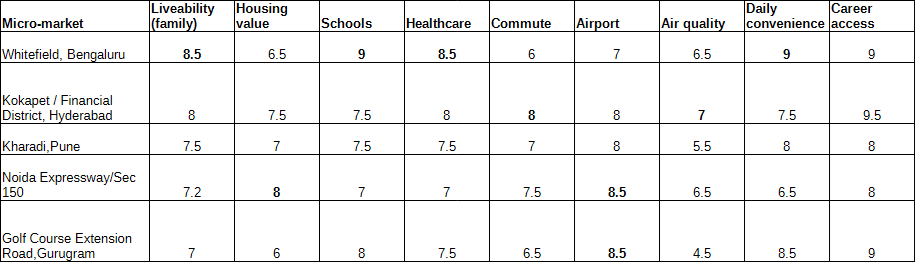 Scores run 1-10 and are relative to this five-market set and this family profile; they are not ratings for whole cities. Bold marks the top score in each column. GRAI defines housing value as value for money (cost versus what you get), not cheapness alone. GRAI rated its own confidence as medium: evidence is strongest for Whitefield and Kokapet, so treat the ranking as directional.
Read across the columns and the ranking stops being one-dimensional:
Whitefield leads on schools, healthcare and daily convenience, but has the weakest commute.
Kokapet leads on career access, commute and air quality.
Kharadi is the balanced middle, held back by air quality.
Sector 150 leads on housing value, but trails on schools and daily convenience.
GCER ties for the best airport access, with the poorest air quality in the set.
Every choice here is a trade.
City gets you onto the shortlist. The locality decides whether you can actually live there.
Once housing and liveability are separated, "best city" stops making sense. Better to start from the household.
| Returnee profile | Stronger starting shortlist | Why |
|---|---|---|
| Career maximiser | Whitefield, Kokapet, Golf Course Extension Road | Deepest professional ecosystems; usually means renting first or bringing more capital |
| Career with lower housing burn | Sholinganallur, Kharadi | Serious employment base with 2-4 years of runway left |
| Capital-preservation reset | Kakkanad, Saravanampatti, Mysuru | More than ₹1 crore left after buying |
| Founder or remote professional | Porvorim, Kakkanad, Whitefield | Portable work changes the location equation |
| Lifestyle-first family | Mysuru, Coimbatore, Kochi, Goa | Space and pace over employer density |
| NCR family with roots nearby | Dwarka, Golf Course Extension Road or Sector 150 | Office and family geography outweigh headline price |
A senior AI leader can rationally choose Whitefield and spend almost all of ₹2.55 crore on housing, because career optionality is worth paying for. A remotely employed couple with parents in Tamil Nadu can rationally choose Coimbatore and keep more than a crore. A founder can knowingly pay Goa prices for a lifestyle.
They are not disagreeing about which city is best. They are answering different questions.
A generic article can only take this decision so far.
The real comparison needs your actual capital, preferred home size, children's schooling, work location, distance from parents, airport needs and tolerance for commuting. GRAI puts those variables into one decision instead of ranking cities on price alone.
Prompts worth trying:
"I have ₹2.5 crore after selling my US home. Compare a 3BHK in Whitefield, Kokapet, Kharadi, Sector 150 and Kakkanad and show how much capital I'd have left after purchase costs."
"Compare renting for 12 months with buying immediately after I move back to India. Include rent, purchase costs and the opportunity cost of tying up my capital."
"My spouse and I work remotely and have two school-age children. Compare Goa, Kochi, Mysuru and Coimbatore on housing, schools, healthcare, airport access and GRAI's Liveability Index."
"I want to stay in AI and technology leadership. Compare Bengaluru, Hyderabad, Pune and Gurugram on career optionality, family liveability and how much of my ₹3 crore each housing market would consume."
What you get back is not another "best cities in India" list. It is a shortlist built around the life your family is actually trying to build.
Ask GRAI to build a personalised shortlist of Indian corridors based on your capital, career, and school needs: https://internationalreal.estate/chat
There is no universal winner. Bengaluru offers the deepest technology-career market, and in GRAI's family comparison Whitefield ranked first for liveability and schools. Pune's Kharadi and Chennai's Sholinganallur combine strong employment bases with lower median 3BHK prices. Kochi, Coimbatore and Mysuru preserve far more capital for households whose careers are portable.
For many returning families, renting for 6-12 months makes sense even if they can buy outright. A year of furnished 3BHK rent in the corridors we compared costs roughly 2-6% of ₹2.55 crore, far less than undoing the wrong purchase.
There is no meaningful universal number. A better measure is how much liquid capital remains after housing and how many years of family spending it covers. In this article's example, the same ₹2.55 crore leaves anywhere from about five years of runway to a shortfall, depending on the corridor.
Coimbatore, Kochi and Mysuru deserve serious consideration for remote workers and households with flexible careers. Zoho's Tenkasi location shows serious technology work can exist outside the metros, although the employer ecosystem is much thinner than Bengaluru's or Hyderabad's.
It can be. If access to India's deepest technology market materially affects your earnings, paying the Whitefield premium is rational. But in our example, buying a median Whitefield 3BHK leaves about four months of family spending, so renting first or bringing more capital is worth considering.
Yes. USD/INR moved between about ₹89.65 and ₹97.11 in 2026, a spread worth roughly ₹19.7 lakh on $264,000. That is more than a year's rent in any corridor compared here.
Article 1: What Happens to Your Home If You Lose Your H-1B Job?
Article 2: Will H-1B Visa Changes Affect Home Prices? What 89 US Markets Show
Article 3: Should You Sell or Rent Your US Home Before Moving Back to India?
Research note: Property figures are online asking prices and rental indicators reviewed in October 2026, not completed transactions or valuations. Medians are used where possible to reduce distortion from outlier listings. Saravanampatti is shown as a listed range because a robust median was not available, and Mysuru uses city-wide data because locality samples were too thin. Unit sizes and specifications differ by corridor. The runway analysis adds a standardised 7% purchase-cost reserve for comparison only; actual stamp duty, registration and brokerage vary by state, buyer and transaction. GRAI Liveability scores are specific to the stated household profile and relative to the five-market peer set.
Disclaimer: This article is general research. It is not real-estate, financial, tax, legal or investment advice. Verify transaction costs, tax treatment, banking status and suitability for your own circumstances with qualified professionals.
Last updated: October 12, 2026


