Ask GRAI Anything
Your Real Estate Questions, Answered Instantly via Chat

Help us make GRAI even better by sharing your feature requests.
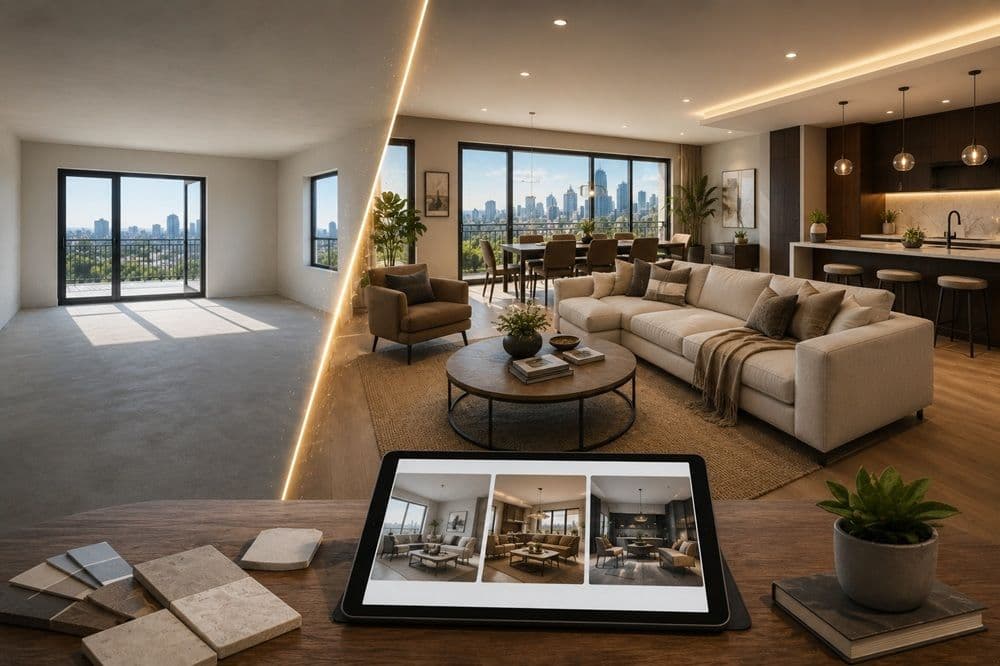
For most of modern real estate history, sellers competed using three things:
Location
Square footage
Pricing
But in 2026, another variable has quietly become just as powerful: Visual Certainty.
Today’s buyers don’t simply evaluate properties. They evaluate lifestyles, renovation potential, emotional fit, future flexibility, and perceived upside - all within seconds of viewing a listing online.
This changes everything.
An empty apartment no longer feels “minimal.” It feels unfinished.
A dated kitchen no longer feels “livable.” It feels expensive.
A poorly planned layout no longer feels “quirky.” It feels risky.
In a market flooded with inventory photos, AI-generated inspiration, Pinterest-perfect interiors, and algorithm-driven expectations, imagination has become a competitive advantage. And increasingly, that imagination is being powered by AI.
At the center of this shift is GRAI - your real estate AI advisor - which enables agents, homeowners, developers, and investors to generate contextual staging, renovation previews, and layout optimizations that directly influence buyer psychology, time-on-market, and final offer strength.
The industry once staged homes physically after construction. Now, AI stages the future before decisions are even made.
Most real estate transactions fail emotionally before they fail financially.
A buyer enters a listing and subconsciously asks:
Can I see myself living here?
Will this renovation become a nightmare?
Is this layout worth the asking price?
How much money will I need after purchase?
Will this age well?
Is this space flexible enough for my future?
Traditionally, answering those questions required:
Contractors
Architects
Mood boards
Renovation estimates
Weeks of uncertainty
That delay kills momentum. And in real estate, momentum matters. The longer a property stays on the market, the weaker the seller’s negotiating position becomes. DOM - Days on Market - doesn’t just measure time. It measures perceived desirability.
Once a listing sits too long:
Buyers assume hidden problems
Lowball offers increase
Urgency disappears
Agents lose leverage
Price reductions become inevitable
This creates a dangerous spiral.
The irony?
Many properties fail not because they are bad assets - but because buyers cannot visualize their potential fast enough.
That is the gap GRAI closes.
Traditional staging is expensive, slow, and limited to one aesthetic direction. AI staging changes the equation entirely.
With GRAI, sellers and agents can instantly generate multiple contextual design paths tailored to:
Buyer demographics
City-specific preferences
Architectural style
Budget levels
Investment goals
Climate and lifestyle expectations
The result is not simply “better photos.” It is scenario-based persuasion.
A 2-bedroom condo in downtown Miami struggled for nearly 70 days without serious traction.
The issue wasn’t pricing. It was ambiguity.
The space looked generic, cold, and difficult to interpret online. Instead of lowering the asking price, the listing agent used GRAI to generate three targeted design scenarios.
Prompt:
“Design modern hybrid workspace apartment with minimalist finishes, warm lighting, ergonomic office area, optimized for remote work lifestyle.”
GRAI generated:
Convertible office nook
Acoustic panels
Matte oak textures
Warm indirect lighting
Tech-oriented staging
This appealed to younger tech buyers migrating from New York and San Francisco.
Prompt:
“Create luxury hospitality-inspired Miami condo with marble kitchen, soft neutral palette, skyline-oriented furniture placement, and resort-style atmosphere.”
GRAI generated:
High-end resort aesthetic
Expansive entertaining zones
Premium finish suggestions
Lighting calibrated to Miami’s tropical daylight
This targeted Latin American and Middle Eastern buyers seeking second homes.
Prompt:
“Optimize condo for premium short-term rental yield with durable materials, flexible sleeping layout, and maintenance-efficient finishes.”
GRAI generated:
Modular furniture strategy
Increased sleeping capacity
Durable flooring
ROI-focused layout logic
This appealed directly to cash-flow investors.
Within 11 days:
Showing requests increased dramatically
Online engagement rose
Multiple offers were submitted
The property sold above revised expectations
Nothing structural changed. Only the visualization of possibility did.
This is the emerging power of AI in real estate: buyers don’t buy properties - they buy the version of themselves they see inside them.
Explore how GRAI can help you visualize property potential and close deals faster: https://internationalreal.estate/chat
Buyers fear uncertainty more than price. A buyer will often pay more for clarity than gamble on ambiguity.
GRAI reduces that fear by generating:
Renovation previews
Localized material estimates
Labor forecasts
Layout alternatives
Feasibility indicators
Value-add scenarios
Instead of imagining renovation risk, buyers can evaluate actual pathways with instant accurate cost estimations powered by GRAI
Construction inflation, labor shortages, and regulatory complexity have transformed renovation into a psychological barrier.
A kitchen renovation in Dallas may cost $30,000. The same renovation in London or Singapore may exceed $120,000 depending on compliance, materials, and labor.
Without contextual intelligence, buyers delay decisions. GRAI turns renovation into a measurable equation.
Across global markets, poor layouts quietly destroy value.
Examples include:
Oversized corridors
Dark transitional zones
Underutilized dining areas
Bad circulation
Low natural light flow
Poor storage planning
AI can now identify these inefficiencies instantly.
A well-optimized 900 sq ft apartment often outperforms a poorly designed 1,100 sq ft unit in:
Resale value
Rental demand
Buyer engagement
Livability scores
Perceived luxury
Why?
Because buyers experience space emotionally - not mathematically.
GRAI can simulate:
Open-plan conversions
Kitchen relocations
Natural light improvements
Additional bedroom scenarios
Flexible workspace additions
Storage optimization
Luxury flow enhancements
And unlike standard visualization software, it does so while accounting for:
Local building logic
Regional design expectations
Climate conditions
Renovation feasibility
Cost implications
This transforms design from decoration into financial engineering.
The role of the agent is evolving rapidly.Agents are no longer just transaction managers.
They are narrative builders.
The best-performing agents in 2026 use AI-driven design to:
Justify pricing
Reduce buyer hesitation
Accelerate emotional attachment
Differentiate listings
Increase perceived value
Shorten negotiation cycles
In competitive markets, this advantage compounds quickly.
Expensive
Time-consuming
Physically limited
One design direction only
Difficult for vacant or remote properties
Instant
Scalable
City-specific
Multiple buyer personas
Renovation-aware
ROI-oriented
Remotely deployable
This is not a replacement for physical staging. It is a strategic layer above it.
Also Read: From Prompt to Plan: GRAI Transforms Design Workflow
One of the fastest-growing trends in luxury and mid-market real estate is pre-sale optimization.
Instead of waiting for a buyer to imagine upgrades, sellers now proactively generate:
Redesign concepts
Renovation packages
Expansion scenarios
Furnishing pathways
Exterior enhancements
before the property even hits the market. This changes buyer perception immediately.
A property transforms from:
“Here’s what it is.”
to
“Here’s what it could become.”
That shift is often the difference between a stagnant listing and a bidding war.
Most AI image tools generate attractive visuals detached from reality. GRAI generates contextual real estate intelligence.
It understands:
Climate
Buyer psychology
Architectural typologies
Renovation economics
Local construction costs
Market preferences
Resale logic
Rental optimization
Feasibility constraints
That distinction is critical because in real estate, beautiful but impractical design destroys trust. GRAI’s outputs are persuasive because they are grounded in possibility.
Over the next five years, static listings will increasingly disappear.
Buyers will expect:
Instant redesign previews
Renovation ROI simulations
Personalized staging
Layout alternatives
Climate-aware upgrades
AI-guided value engineering
Properties will behave more like configurable products than fixed assets and the platforms shaping the future of AI in real estate will be the ones that contextualize design, economics, and buyer psychology together
GRAI is positioning itself at the center of that shift.
If you are a:
Real estate agent
Homeowner
Investor
Developer
Architect or
Renovation-focused buyer
GRAI gives you the ability to transform listings into decision-ready experiences.
Generate:
AI-powered staging
Renovation previews
Layout optimization scenarios
Localized cost forecasts
Buyer-persona-based designs
Resale-oriented improvements
The future of selling property is no longer about showing square footage. It is about showing potential with clarity and the sellers who can visualize that future first will win faster, negotiate stronger, and sell smarter.
Use GRAI to transform your listings into decision-ready experiences with AI-powered insights: https://internationalreal.estate/chat
AI-powered staging uses artificial intelligence to digitally transform empty or outdated spaces into fully designed, market-ready interiors. Unlike traditional staging, AI staging allows agents and sellers to instantly generate multiple design styles tailored to different buyer personas, budgets, and regional preferences.
AI staging reduces DOM by helping buyers emotionally connect with a property faster. When buyers can clearly visualize how a space could look and function, hesitation decreases, engagement increases, and offers tend to arrive sooner.
Yes. Renovation previews help buyers understand the future potential of a property before purchasing it. By visualizing upgraded kitchens, optimized layouts, or modernized interiors with localized cost estimates, sellers can justify stronger pricing and attract higher-quality offers.
Most AI image tools create visually appealing renders without considering feasibility, climate, costs, regulations, or buyer psychology. GRAI is trained specifically for real estate and generates contextual designs that align with local architecture, construction realities, renovation economics, and resale potential.
Yes. GRAI can generate personalized staging and renovation concepts tailored to:
Luxury buyers
Investors
Remote professionals
Families
Short-term rental owners
International buyers
This allows agents and sellers to market one property in multiple strategic ways.
Absolutely. Luxury buyers often purchase based on emotional perception and lifestyle alignment. AI-generated luxury staging helps showcase aspirational living scenarios, premium finishes, and architectural possibilities that elevate perceived value and strengthen negotiation leverage.
A better layout improves:
Natural light flow
Livability
Functionality
Storage efficiency
Furniture placement
Perceived spaciousness
Even small layout improvements can significantly increase buyer interest, rental demand, and long-term resale performance.
Yes. GRAI provides localized renovation insights based on city-specific labor rates, material pricing, and design feasibility. This helps buyers and sellers make informed decisions before committing to costly upgrades.
Design preferences differ across cities and cultures. A layout that performs well in London may not work in Dubai, Mumbai, or Singapore. GRAI adapts designs to climate, culture, buyer expectations, and regional architecture standards to create more accurate and persuasive outputs.
No. AI enhances professionals rather than replacing them. Agents, designers, and developers who use AI tools like GRAI gain a competitive advantage by delivering faster insights, stronger presentations, and more data-backed recommendations.
Real estate buyers no longer purchase empty spaces - they purchase clearly visualized potential. AI-powered staging and contextual renovation previews are transforming how properties are marketed by reducing hesitation, accelerating emotional connection, and helping buyers confidently imagine future possibilities. Layout optimization has also become a major value driver, influencing resale performance, rental demand, functionality, and perceived luxury across global markets.
GRAI stands apart by combining design intelligence with feasibility analysis, climate awareness, buyer psychology, localized construction costs, and market-specific insights within one contextual AI platform. This allows agents, developers, homeowners, and investors to make faster and more informed decisions backed by both visual and financial clarity. As the industry evolves, real estate professionals are increasingly becoming strategic storytellers who use AI-generated design experiences to shorten Days on Market, strengthen negotiation leverage, and increase offer quality.
Unlike generic AI image tools that generate attractive but impractical visuals, GRAI delivers contextual real estate intelligence grounded in real-world usability and investment logic. The future of property sales will be interactive, personalized, and AI-driven, where buyers expect renovation previews, staging scenarios, and layout alternatives before making decisions. In this new era, design is no longer cosmetic - it directly impacts ROI, liquidity, buyer confidence, and long-term property value.


